
Winging It
About this episode
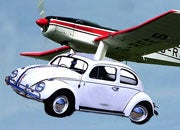
Ask anyone what extraordinary powers they’d love to have, and you’re sure to hear “be able to fly.” We’ve kind of scratched that itch with airplanes. But have we gone as far as we can go, or are better flying machines in our future? And whatever happened to our collective dream of flying cars? We look at the evolution - and the future - of flight.
Animals and insects have taught us a lot about the mechanics of becoming airborne. But surprises remain. For example, bats may flit around eccentrically, but they are actually more efficient fliers than birds.
Meanwhile, new technology may change aviation when self-healing material repairs structural cracks in mid-flight. And a scientist who worked on flying cars for DARPA says he’s now working on the next best thing.
Guests:
Merlin Tuttle – Ecologist and founder of Bat Conservation International. Executive director of Merlin Tuttle’s Bat Conservation and author of The Secret Life of Bats: My Adventures with the World’s Most Misunderstood Animals. Join his effort and browse his stunning photography at http://www.merlintuttle.com/
David Alexander - Ecologist, evolutionary biologist, the University of Kansas, author of On the Wing: Insects, Pterosaurs, Birds, Bats and the Evolution of Animal Flight
Duncan Wass - Professor of chemistry, University of Bristol, U.K.
Sanjiv Singh - Research professor, Robotics Institute, Carnegie Mellon University
Learn more about your ad choices. Visit megaphone.fm/adchoices
More from Big Picture Science
Over a hundred years ago two famous men met for a séance. One, the creator of an exceedingly rational pipe-smoking fictional detective, and the other, a showman who amazed audiences with feats of esca…
As their name suggests, “forever chemicals” have extraordinary staying power. When these nearly indestructible compounds find their way into our soil and water, they don’t break down for hundreds or t…
We can now follow where Monarch butterflies go when they leave our gardens with tiny sensors that track their impressive 3,000-mile migrations from Canada to Mexico. The significant challenges that th…
Carbon dioxide is more than an industrial pollutant driving climate change. The gas also played a pivotal part in the dramatic story of the beginning of all life. Starting in the ocean depths, dissolv…
How did scientists learn to peer inside the atom? In this preview from the BBC's In Our Time, physicist Harry Cliff tells the story of the birth of the particle accelerator, from Ernest Rutherford's c…