
What Do You Make Of It?
About this episode
You are surrounded by products. Most of them, factory-made. Yet there was a time when building things by hand was commonplace, and if something stopped working, well, you jumped into the garage and fixed it, rather than tossing it into the circular file.
Participants at the Maker Faire are bringing back the age of tinkering, one soldering iron and circuit board at a time. Meet the 12-year old who built a robot to solve his Rubik’s Cube, and learn how to print shoes at home. Yes, “print.”
Plus, the woman who started Science Hack Day … the creation of a beard-slash-cosmic-ray detector … the history of the transistor … and new materials that come with nervous systems: get ready for self-healing concrete.
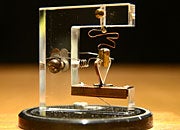
(Photo is a model of the first transistor built in 1947 at the Bell Telephone Labs in New Jersey that led to a Nobel Prize. Today’s computers contain many million transistors … but they’re a lot smaller than this one, which is about the size of a quarter. Credit: Seth Shostak.)
Guests:
Lucy Beard – Founder of Feetz
Mark Miodownik – Materials scientist, director of the Institute of Making, University College, London, and author of Stuff Matters: Exploring the Marvelous Materials That Shape Our Man-Made World
Steve Nelson – Team K.I.S.S. Robotics, maker of Beer2D2
Dan Lankford – Managing director, Wavepoint Ventures
Ariel Waldman – Founder, Spacehack.org, global instigator of Science Hack Day
Saurabh Narain – 12 year-old participant in Maker Faire
Descripción en español
Learn more about your ad choices. Visit megaphone.fm/adchoices
More from Big Picture Science
Over a hundred years ago two famous men met for a séance. One, the creator of an exceedingly rational pipe-smoking fictional detective, and the other, a showman who amazed audiences with feats of esca…
As their name suggests, “forever chemicals” have extraordinary staying power. When these nearly indestructible compounds find their way into our soil and water, they don’t break down for hundreds or t…
We can now follow where Monarch butterflies go when they leave our gardens with tiny sensors that track their impressive 3,000-mile migrations from Canada to Mexico. The significant challenges that th…
Carbon dioxide is more than an industrial pollutant driving climate change. The gas also played a pivotal part in the dramatic story of the beginning of all life. Starting in the ocean depths, dissolv…
How did scientists learn to peer inside the atom? In this preview from the BBC's In Our Time, physicist Harry Cliff tells the story of the birth of the particle accelerator, from Ernest Rutherford's c…