
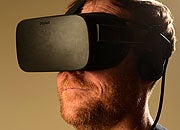
We Are VR
About this episode
(repeat) Will virtual reality make you a better person? It’s been touted as the “ultimate empathy machine,” and one that will connect people who are otherwise emotionally and physically isolated. The promise of the technology has come a long way since BiPiSci last took a VR tour. Find out why researchers say virtual reality is no longer an exclusive club for gamers, but a powerful tool to build community.
Seth puts on a VR headset for an immersive experience of a man who’s evicted from his apartment. Find out why researchers say the experience creates empathy and sparks activism to address homelessness.
Also, why our spouses will love our avatars as much as they do us, the dark side of VR as a space for unchecked harassment, and consider: what if you’re already living a simulation created by your brain?
Guests:
Peter Rubin – Editor for Wired, author of “Future Presence: How Virtual reality is Changing Human Connection, Intimacy, and the Limits of Ordinary Life”
Jeremy Bailenson – Professor of Communication at Stanford University, founding director of the Virtual Human Interaction Lab, and author of “Experience on Demand: What Virtual Reality Is, How It Works, and What It Can Do”
Carolina Cruz-Neira – Director of the Emerging Analytics Center at the University of Arkansas, Little Rock
Thomas Metzinger – Philosopher of Mind and Cognitive Science, at Johannes Gutenberg University of Mainz, Germany
Learn more about your ad choices. Visit megaphone.fm/adchoices
More from Big Picture Science
Over a hundred years ago two famous men met for a séance. One, the creator of an exceedingly rational pipe-smoking fictional detective, and the other, a showman who amazed audiences with feats of esca…
As their name suggests, “forever chemicals” have extraordinary staying power. When these nearly indestructible compounds find their way into our soil and water, they don’t break down for hundreds or t…
We can now follow where Monarch butterflies go when they leave our gardens with tiny sensors that track their impressive 3,000-mile migrations from Canada to Mexico. The significant challenges that th…
Carbon dioxide is more than an industrial pollutant driving climate change. The gas also played a pivotal part in the dramatic story of the beginning of all life. Starting in the ocean depths, dissolv…
How did scientists learn to peer inside the atom? In this preview from the BBC's In Our Time, physicist Harry Cliff tells the story of the birth of the particle accelerator, from Ernest Rutherford's c…