
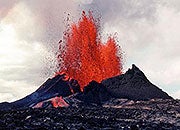
Volcanic Mind Melt
About this episode
The Earth’s surface is dappled with more than a thousand volcanoes. They mark the edges of tectonic plates, spewing hot gas and ash, and boiling over with lava. We can detect the warning signs of an eruption, but why is it still so hard to predict?
Meet a few currently active hot heads: Mauna Loa, Nyiragongo, Fagradalsfjall, and Soufrière – and find out what gives them individual personalities. Plus, what a newly excavated snack bar in Pompeii, buried and preserved when Vesuvius erupted in 79 AD, can teach us about eruptions.
Guests:
Christopher Jackson – Chair of Sustainable Geosciences at the University of Manchester
Thorvaldur Thordarson – Professor in Volcanology and Petrology at the University of Iceland
Maite Maguregui – Professor, Department of Analytical Chemistry at the University of the Basque Country, Spain
Silvia Perez-Diez – Researcher in the Department of Analytical Chemistry at the University of the Basque Country, Spain
Alia Wallace – Archaeologist with the Bureau of Land Management in Colorado with a PhD from University College London
Jazmin Scarlett – Teaching fellow in physical geology, Newcastle University
Learn more about your ad choices. Visit megaphone.fm/adchoices
More from Big Picture Science
Over a hundred years ago two famous men met for a séance. One, the creator of an exceedingly rational pipe-smoking fictional detective, and the other, a showman who amazed audiences with feats of esca…
As their name suggests, “forever chemicals” have extraordinary staying power. When these nearly indestructible compounds find their way into our soil and water, they don’t break down for hundreds or t…
We can now follow where Monarch butterflies go when they leave our gardens with tiny sensors that track their impressive 3,000-mile migrations from Canada to Mexico. The significant challenges that th…
Carbon dioxide is more than an industrial pollutant driving climate change. The gas also played a pivotal part in the dramatic story of the beginning of all life. Starting in the ocean depths, dissolv…
How did scientists learn to peer inside the atom? In this preview from the BBC's In Our Time, physicist Harry Cliff tells the story of the birth of the particle accelerator, from Ernest Rutherford's c…