
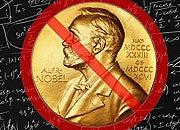
Too Big To Prove
About this episode
(Repeat) Celebrations are in order for the physicists who won the 2017 Nobel Prize, for the detection of gravitational waves. But the road to Stockholm was not easy. Unfolding over a century, it went from doubtful theory to daring experiments and even disrepute. 100 years is a major lag between a theory and its confirmation, and new ideas in physics may take even longer to prove.
Why it may be your great, great grandchildren who witness the confirmation of string theory. Plus, the exciting insights that gravitational waves provide into the phenomena of our universe, beginning with black holes.
And, physics has evolved - shouldn’t its rewards? A case for why the Nobel committee should honor collaborative groups rather than individuals, and the scientific breakthroughs it’s missed.
Guests:
Janna Levin- Physicist and astronomer at Barnard College at Columbia University, and the author of the story of LIGO, “Black Hole Blues and Other Songs from Outer Space.”
Roland Pease- BBC reporter, producer, and host of “Science in Action.”
David Gross- Theoretical physicist, string theorist, University of California, Santa Barbara, Kavli Institute for Theoretical Physics, winner, 2004 Nobel Prize in Physics.
Learn more about your ad choices. Visit megaphone.fm/adchoices
More from Big Picture Science
Over a hundred years ago two famous men met for a séance. One, the creator of an exceedingly rational pipe-smoking fictional detective, and the other, a showman who amazed audiences with feats of esca…
As their name suggests, “forever chemicals” have extraordinary staying power. When these nearly indestructible compounds find their way into our soil and water, they don’t break down for hundreds or t…
We can now follow where Monarch butterflies go when they leave our gardens with tiny sensors that track their impressive 3,000-mile migrations from Canada to Mexico. The significant challenges that th…
Carbon dioxide is more than an industrial pollutant driving climate change. The gas also played a pivotal part in the dramatic story of the beginning of all life. Starting in the ocean depths, dissolv…
How did scientists learn to peer inside the atom? In this preview from the BBC's In Our Time, physicist Harry Cliff tells the story of the birth of the particle accelerator, from Ernest Rutherford's c…