
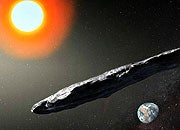
Space Rocks!
About this episode
It’s not a bird or a plane, and probably not an alien spaceship, although the jury’s still deliberating that one. Some astronomers have proposed that an oddly-shaped object that recently passed through our Solar System could be an alien artifact. We consider the E.T. explanation for ‘Oumuamua, but also other reasons asteroids are invigorating our imagination. Are these orbiting rocks key to our future as a spacefaring species?
Find out why traditional incentives for human exploration of space – such as political rivalry –aren’t igniting our rockets the way they once did, but why the potentially trillions of dollars to be made mining asteroids might.
These small bodies may also hold the key to our ancient past: the New Horizons flyby of Thule in early 2019 will provide an historic look at a distant Kuiper belt object, and provide clues about the formation of the Solar System.
Guests:
Roger Launius – Former associate director of the National Air and Space Museum at the Smithsonian and chief historian for NASA
J. L.Galache – Asteroid astronomer and co-founder and CTO of Aten Engineering
Mark Showalter – Planetary scientist and Senior Research Scientist at the SETI Institute and a member of the New Horizons team
Avi Loeb – Professor of Science at Harvard and chair of the Department of Astronomy
Learn more about your ad choices. Visit megaphone.fm/adchoices
More from Big Picture Science
Over a hundred years ago two famous men met for a séance. One, the creator of an exceedingly rational pipe-smoking fictional detective, and the other, a showman who amazed audiences with feats of esca…
As their name suggests, “forever chemicals” have extraordinary staying power. When these nearly indestructible compounds find their way into our soil and water, they don’t break down for hundreds or t…
We can now follow where Monarch butterflies go when they leave our gardens with tiny sensors that track their impressive 3,000-mile migrations from Canada to Mexico. The significant challenges that th…
Carbon dioxide is more than an industrial pollutant driving climate change. The gas also played a pivotal part in the dramatic story of the beginning of all life. Starting in the ocean depths, dissolv…
How did scientists learn to peer inside the atom? In this preview from the BBC's In Our Time, physicist Harry Cliff tells the story of the birth of the particle accelerator, from Ernest Rutherford's c…