
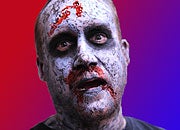
Skeptic Check: Zombies Aren't Real
About this episode
Zombies are making a killing in popular culture. But where did the idea behind these mythical, cerebrum-supping nasties come from? Discover why they may be a hard-wired inheritance from our Pleistocene past.
Also, how a whimsical mathematical model of a Zombie apocalypse can help us withstand earthquakes and disease outbreaks, and how the rabies virus contributed to zombie mythology.
Plus, new ideas for how doctors should respond when humans are in a limbo state between life and death: no pulse, but their brains continue to hum.
Meet the songwriter who has zombies on the brain …. and we chase spaced-out animated corpses in the annual Run-For-Your-Lives foot race.
Guests:
Guy P. Harrison – Science writer and author of 50 Popular Beliefs That People Think Are True
Jonathan Coulton – Singer and songwriter
Robert Smith? – Mathematician and epidemiologist at the University of Ottawa, in Canada
Dick Teresi – Science writer and author of The Undead: Organ Harvesting, the Ice-Water Test, Beating Heart Cadavers—How Medicine Is Blurring the Line Between Life and Death
Bill Wasik and Monica Murphy – - Respectively Senior Editor at Wired Magazine and veterinarian, and the co-authors of Rabid: A Cultural History of the World’s Most Diabolical Virus
Descripción en español
First released November 12, 2012
Learn more about your ad choices. Visit megaphone.fm/adchoices
More from Big Picture Science
Over a hundred years ago two famous men met for a séance. One, the creator of an exceedingly rational pipe-smoking fictional detective, and the other, a showman who amazed audiences with feats of esca…
As their name suggests, “forever chemicals” have extraordinary staying power. When these nearly indestructible compounds find their way into our soil and water, they don’t break down for hundreds or t…
We can now follow where Monarch butterflies go when they leave our gardens with tiny sensors that track their impressive 3,000-mile migrations from Canada to Mexico. The significant challenges that th…
Carbon dioxide is more than an industrial pollutant driving climate change. The gas also played a pivotal part in the dramatic story of the beginning of all life. Starting in the ocean depths, dissolv…
How did scientists learn to peer inside the atom? In this preview from the BBC's In Our Time, physicist Harry Cliff tells the story of the birth of the particle accelerator, from Ernest Rutherford's c…