
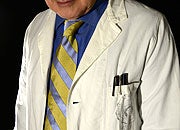
Skeptic Check: Your Inner Lab Coat
About this episode
ENCORE Sherlock Holmes doesn’t have a science degree, yet he thinks rationally – like a scientist. You can too! Learn the secrets of being irritatingly logical from the most famous sleuth on Baker Street. Plus, discover why animal trackers 100,000 years ago may have been the first scientists, and what we can learn from about deductive reasoning from today’s African trackers.
Also, the author of a book on teaching physics to your dog provides tips for unleashing your inner scientist, even if you hated science in school.
And newly-minted scientists imagine classes they wish were available to them as grad students, such as “You Can’t Save the World 101.”
Guests:
Louis Liebenberg - Co-founder and Executive Director of Cybertracker Conservation, associate of human evolutionary biology, Harvard University
Maria Konnikova - Psychologist, journalist and author of Mastermind: How to Think Like Sherlock Holmes. Her weekly blog on psychology is at com.
Chad Orzel - Physicist and astronomer at Union College, and author of How to Teach Physics to Your Dog and Eureka: Discovering Your Inner Scientist
And newly-minted scientists Michael Kemp, Toni Lyn Morelli, Ilona Kotlewska, and Yonatan Lipsitz
First released February 9, 2015.
Learn more about your ad choices. Visit megaphone.fm/adchoices
More from Big Picture Science
Over a hundred years ago two famous men met for a séance. One, the creator of an exceedingly rational pipe-smoking fictional detective, and the other, a showman who amazed audiences with feats of esca…
As their name suggests, “forever chemicals” have extraordinary staying power. When these nearly indestructible compounds find their way into our soil and water, they don’t break down for hundreds or t…
We can now follow where Monarch butterflies go when they leave our gardens with tiny sensors that track their impressive 3,000-mile migrations from Canada to Mexico. The significant challenges that th…
Carbon dioxide is more than an industrial pollutant driving climate change. The gas also played a pivotal part in the dramatic story of the beginning of all life. Starting in the ocean depths, dissolv…
How did scientists learn to peer inside the atom? In this preview from the BBC's In Our Time, physicist Harry Cliff tells the story of the birth of the particle accelerator, from Ernest Rutherford's c…