
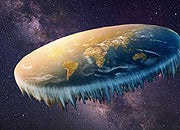
Skeptic Check: Flat Earth
About this episode
(repeat) The Earth is not round. Technically, it’s an oblate spheroid. But for some people, the first statement is not even approximately correct. Flat Earthers believe that our planet resembles – not a slightly squashed grapefruit – but a thick pancake. A journalist who covered a Flat Earth convention describes the rationale behind this ever-more popular belief.
So how do you establish science truth? We look at the difference between a truly scientific examination of extraordinary claims and approaches that feel and look science-y but aren’t.
Find out how one man will use telescopes and balloons in the desert to demonstrate that the Earth is a globe, while a biologist runs a test on the waters of Loch Ness to see if it contains prehistoric reptile DNA.
And what happens when amateur investigators chase ghosts, UFOs, and Bigfoot with science instruments, but without an understanding of the scientific method.
Guests:
James Underdown– Executive Director of the Center for Inquiry in Los Angeles and of the Independent Investigations Group. The results of his experiment will be posted here.
Alex Moshakis– Journalist who writes for the Observer, the Guardian, and Esquire. His article on the U.K.’s first Flat Earth convention appeared in May, 2018 in the
Harry Dyer– Lecturer in education at the University of East Anglia. His article about the flat earth convention is titled "I Watched an Entire Flat Earth Convention for my Research, Here is What I Learned."
Neil Gemmell– Professor in the Department of Anatomy, University of Otago, New Zealand
Sharon Hill– Geologist, science writer, speaker, and author of "Scientifical Americans: The Culture of Amateur Paranormal Researchers."
Learn more about your ad choices. Visit megaphone.fm/adchoices
More from Big Picture Science
Over a hundred years ago two famous men met for a séance. One, the creator of an exceedingly rational pipe-smoking fictional detective, and the other, a showman who amazed audiences with feats of esca…
As their name suggests, “forever chemicals” have extraordinary staying power. When these nearly indestructible compounds find their way into our soil and water, they don’t break down for hundreds or t…
We can now follow where Monarch butterflies go when they leave our gardens with tiny sensors that track their impressive 3,000-mile migrations from Canada to Mexico. The significant challenges that th…
Carbon dioxide is more than an industrial pollutant driving climate change. The gas also played a pivotal part in the dramatic story of the beginning of all life. Starting in the ocean depths, dissolv…
How did scientists learn to peer inside the atom? In this preview from the BBC's In Our Time, physicist Harry Cliff tells the story of the birth of the particle accelerator, from Ernest Rutherford's c…