
Sex Post Facto
About this episode
Birds do it, bees do it, but humans may not do it for much longer. At least not for having children. Relying on sex to reproduce could be supplanted by making babies in the lab, where parents-to-be can select genomes that will ensure ideal physical and behavioral traits.
Men hoping to be fathers should act sooner rather than later. These same advancements in biotechnology could allow women to fertilize their own eggs, making the need for male sperm obsolete.
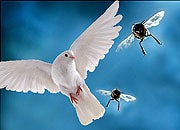
Meanwhile, some animals already reproduce asexually. Find out how female African bees can opt to shut out male bees intent on expanding the hive.
Will engineering our offspring have a down side? Sex creates vital genetic diversity, as demonstrated by evolution of wild animals in urban areas. Find out how birds, rodents and insects use sex in the city to adapt and thrive.
Guests:
Menno Schilthuizen – Biologist and ecologist, at the Naturalis Biodiversity Center and Leiden University in The Netherlands. His New York Times op-ed, “Evolution is Happening Faster Than We Thought,” is here.
Matthew Webster – Evolutionary biologist, Uppsala University, Sweden
Hank Greely – Law professor and ethicist, Stanford University, who specializes in the ethical, legal and social implications of biomedical technologies. His book is “The End of Sex and The Future of Reproduction.”
Learn more about your ad choices. Visit megaphone.fm/adchoices
More from Big Picture Science
Over a hundred years ago two famous men met for a séance. One, the creator of an exceedingly rational pipe-smoking fictional detective, and the other, a showman who amazed audiences with feats of esca…
As their name suggests, “forever chemicals” have extraordinary staying power. When these nearly indestructible compounds find their way into our soil and water, they don’t break down for hundreds or t…
We can now follow where Monarch butterflies go when they leave our gardens with tiny sensors that track their impressive 3,000-mile migrations from Canada to Mexico. The significant challenges that th…
Carbon dioxide is more than an industrial pollutant driving climate change. The gas also played a pivotal part in the dramatic story of the beginning of all life. Starting in the ocean depths, dissolv…
How did scientists learn to peer inside the atom? In this preview from the BBC's In Our Time, physicist Harry Cliff tells the story of the birth of the particle accelerator, from Ernest Rutherford's c…