
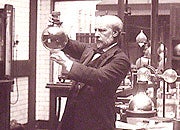
Sesquicentennial Science
About this episode
Today, scientists are familiar to us, but they weren’t always. Even the word “scientist” is relatively modern, dating from the Victorian Era.
And it is to that era we turn as we travel to the University of Notre Dame to celebrate the 150th anniversary of its College of Science with a show recorded in front of a live audience.
Find out how the modern hunt for planets around other stars compares to our knowledge of the cosmos a century and a half ago. Also how faster computers have ushered in the realm of Big Data.
And a science historian describes us what major science frontiers were being crossed during the era of Charles Darwin and germ theory.
It’s then versus now on Sesquicentennial Science!
Recorded at the Eck Center at the University of Notre Dame, February 4th, 2015
Guests:
• Justin Crepp – Professor of physics, University of Notre Dame
• Nitesh Chawla – Professor of computer science and engineering and director of the Interdisciplinary Center for Network Sciences and Applications at Notre Dame
• John Durant – Historian of science, director of the MIT Museum
Learn more about your ad choices. Visit megaphone.fm/adchoices
More from Big Picture Science
Over a hundred years ago two famous men met for a séance. One, the creator of an exceedingly rational pipe-smoking fictional detective, and the other, a showman who amazed audiences with feats of esca…
As their name suggests, “forever chemicals” have extraordinary staying power. When these nearly indestructible compounds find their way into our soil and water, they don’t break down for hundreds or t…
We can now follow where Monarch butterflies go when they leave our gardens with tiny sensors that track their impressive 3,000-mile migrations from Canada to Mexico. The significant challenges that th…
Carbon dioxide is more than an industrial pollutant driving climate change. The gas also played a pivotal part in the dramatic story of the beginning of all life. Starting in the ocean depths, dissolv…
How did scientists learn to peer inside the atom? In this preview from the BBC's In Our Time, physicist Harry Cliff tells the story of the birth of the particle accelerator, from Ernest Rutherford's c…