
Episode 681 · Season 1
Root Causes 681: The Basis for Cryptographic Agility
About this episode
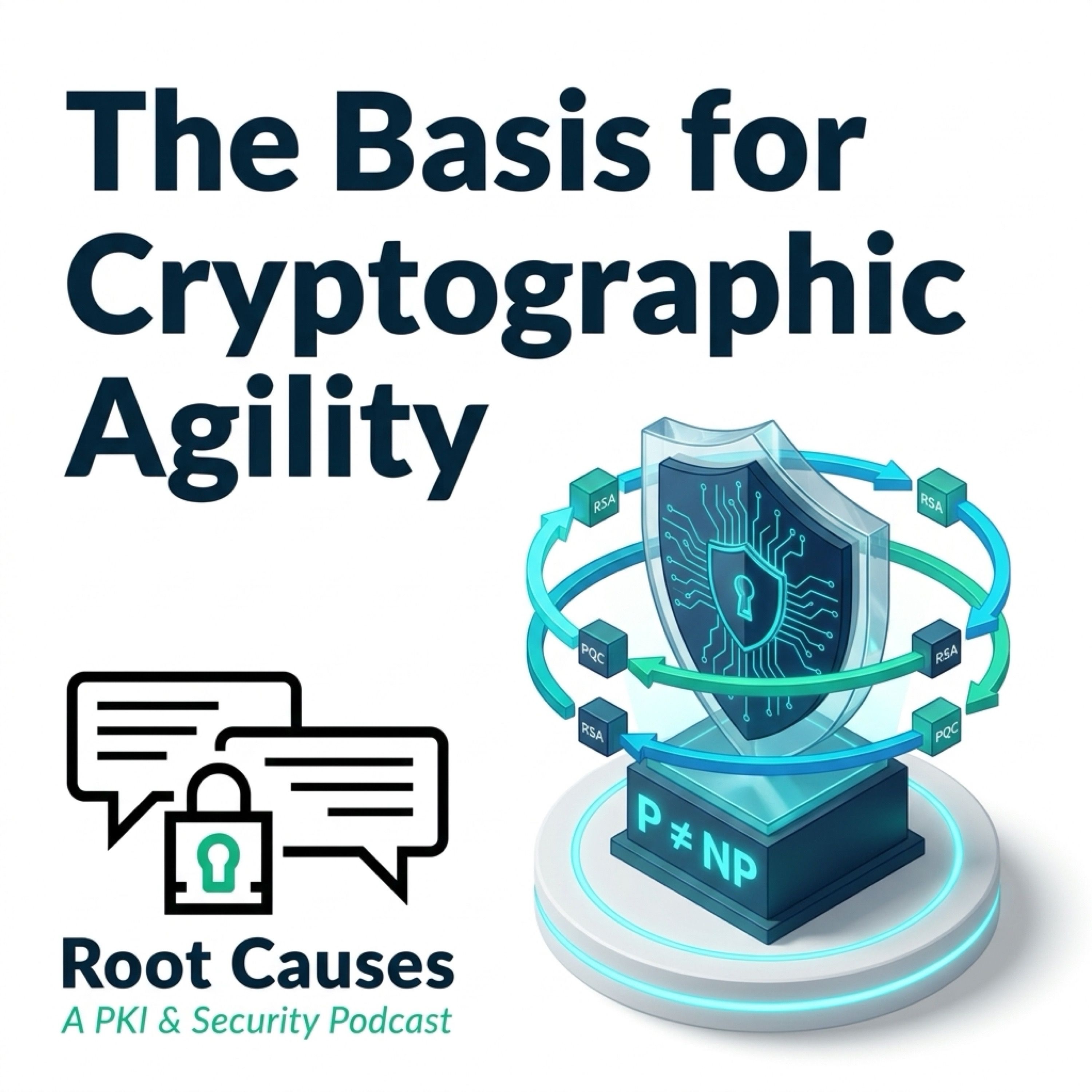
In this episode, Jason and Tim start from the P versus NP question and use a Sudoku puzzle to show the difference between problems that are easy to check and hard to solve. We discuss why RSA and ECC, which rest on factorization, fall to Shor's algorithm and the quantum Fourier transform, and why lattice-based post-quantum algorithms such as ML-DSA were chosen. Because it is impossible to know which hard problem will survive AI-accelerated cryptanalysis, we make the case that cryptographic agility is essential. We also cover NIST's push for math diversity beyond lattices, and Apple's proposed Merkle Tree Certificate root program including SLH-DSA, so that MTCs can act as an abstraction layer that makes swapping algorithms practical.
More from Root Causes: A PKI and Security Podcast
In this episode, "Post Issuance Linting Makes No Sense," Jason and Tim discuss why linting a public TLS certificate after it has already been signed and issued violates the fundamental principle of "m…
In this episode about the geometry of randomness and lattice cryptography, Jason and Tim discuss stochastic calculus, random walks, and why attackers prune their guesses to target the predictable Gaus…
In this episode about building an AI crypto proof factory, Jason and Tim discuss how defenders and cryptographers must move beyond one-off AI vulnerability hunting toward a systematic, repeatable blue…
In this episode about the reported attack on grocery store freezers across Europe, Jason and Tim discuss why the significant operational technology (OT) attack they once predicted seems to have finall…
In this episode about the latest research against RSA-1024, Jason and Tim discuss whether faster attacks on smaller RSA keys bring a break of RSA-2048 any closer. They recap the hardware security modu…