
Episode 692 · Season 1
Root Causes 692: Randomness Has a Shape
About this episode
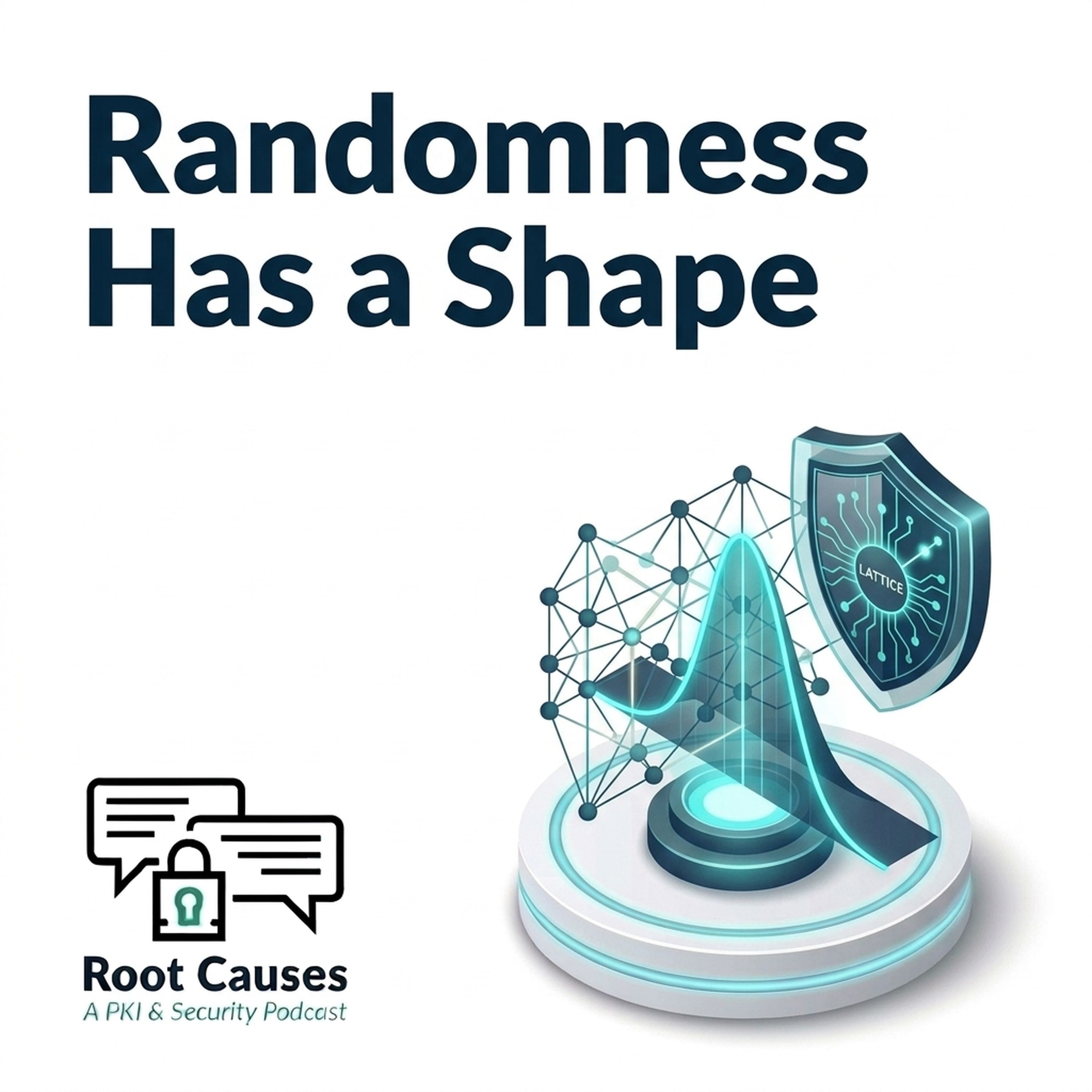
In this episode about the geometry of randomness and lattice cryptography, Jason and Tim discuss stochastic calculus, random walks, and why attackers prune their guesses to target the predictable Gaussian bell-curve cluster where random outcomes naturally land. Building on Micciancio and Regev's foundational work on Gaussian measures, they explain how injecting carefully calibrated "Gaussian fog" (noise) into lattice problems hides the structure of the random walk and makes post-quantum algorithms like ML-DSA extraordinarily difficult to reverse.
Jason Soroko on LinkedIn
https://www.linkedin.com/in/jason-soroko-19b41920/
More from Root Causes: A PKI and Security Podcast
In this episode, "Post Issuance Linting Makes No Sense," Jason and Tim discuss why linting a public TLS certificate after it has already been signed and issued violates the fundamental principle of "m…
In this episode about building an AI crypto proof factory, Jason and Tim discuss how defenders and cryptographers must move beyond one-off AI vulnerability hunting toward a systematic, repeatable blue…
In this episode about the reported attack on grocery store freezers across Europe, Jason and Tim discuss why the significant operational technology (OT) attack they once predicted seems to have finall…
In this episode about the latest research against RSA-1024, Jason and Tim discuss whether faster attacks on smaller RSA keys bring a break of RSA-2048 any closer. They recap the hardware security modu…
In this episode about the key compromise at the public certificate authority eMudhra and its exit from the WebPKI, Jason and Tim discuss how a researcher found intermediate CA keys with only one byte…