
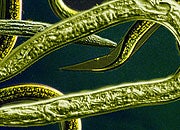
Rip Van Winkle Worm
About this episode
(repeat) Your shower pipes are alive. So are your sinks, books, and floorboards. New studies of our homes are revealing just what species live there – in the thousands, from bacteria to flies to millipedes. Meanwhile, life keeps surprising us by popping up in other unexpected places: the deep biosphere houses the majority of the world’s bacteria and the Arctic tundra has kept worms frozen, but alive, for 40,000 years.
We embrace the multitude of life living on us, in us, and – as it turns out – in every possible ecological niche. Most of it is harmless, some is beneficial, and it’s all testament to the amazing diversity and adaptability of life. In addition, the hardiest organisms suggest where we might find life beyond Earth.
Guests:
Rob Dunn – Professor of applied ecology at North Carolina State University and at the Natural History Museum at the University of Copenhagen. Author of “Never Home Alone: From Microbes to Millipedes, Camel Crickets, and Honeybees, the Natural History of Where We Live.”
Lynn Rothschild – Astrobiologist and synthetic biologist at the NASA Ames Research Center.
Karen Lloyd – Environmental microbiologist and associate professor at the University of Tennessee.
Learn more about your ad choices. Visit megaphone.fm/adchoices
More from Big Picture Science
Over a hundred years ago two famous men met for a séance. One, the creator of an exceedingly rational pipe-smoking fictional detective, and the other, a showman who amazed audiences with feats of esca…
As their name suggests, “forever chemicals” have extraordinary staying power. When these nearly indestructible compounds find their way into our soil and water, they don’t break down for hundreds or t…
We can now follow where Monarch butterflies go when they leave our gardens with tiny sensors that track their impressive 3,000-mile migrations from Canada to Mexico. The significant challenges that th…
Carbon dioxide is more than an industrial pollutant driving climate change. The gas also played a pivotal part in the dramatic story of the beginning of all life. Starting in the ocean depths, dissolv…
How did scientists learn to peer inside the atom? In this preview from the BBC's In Our Time, physicist Harry Cliff tells the story of the birth of the particle accelerator, from Ernest Rutherford's c…