
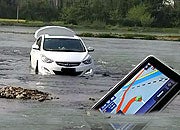
Rerouting... Rerouting
About this episode
(Repeat) Lost your sense of direction? Blame your GPS. Scientists say that our reliance on dashboard devices is eroding our ability to create cognitive maps and is messing with our minds in general. We don’t even look at landmarks or the landscape anymore. We’ve become no more than interfaces between our GPS and our steering wheels.
But in other ways, GPS can spark a new appreciation of the physical world. A real-time flyover app reveals the stunning geological features otherwise invisible from our window seat.
And sensitive electronic sensors let us see where the wild things are and where they go. Learn how scientists put belts on jellyfish and produce maps that reveal the surprising routes taken by various species – from a single wolf, a group of phytoplankton, or a float of crocodiles.
Plus, one man is not ready to say goodbye to the traditional map. Find out why this cartographer insists on paper maps, not digital apps.
Guests:
Julia Frankenstein– Cognitive scientist, Darmstadt Technical University, Germany
Greg Milner– Journalist, author of “Pinpoint: How GPS is Changing Technology, Culture, and our Minds”
Amy Myrbo– Earth scientist, University of Minnesota
Oliver Uberti– Graphic artist and former senior design editor at National Geographic
James Cheshire– Geographer, University College London. Co-author, along with Oliver Uberti, of “Where The Animals Go: Tracking Wildlife with Technology in 50 Maps and Graphics.”
Tom Hedberg– Mapmaker and publisher at Hedberg Maps in Minneapolis, Minnesota
Learn more about your ad choices. Visit megaphone.fm/adchoices
More from Big Picture Science
Over a hundred years ago two famous men met for a séance. One, the creator of an exceedingly rational pipe-smoking fictional detective, and the other, a showman who amazed audiences with feats of esca…
As their name suggests, “forever chemicals” have extraordinary staying power. When these nearly indestructible compounds find their way into our soil and water, they don’t break down for hundreds or t…
We can now follow where Monarch butterflies go when they leave our gardens with tiny sensors that track their impressive 3,000-mile migrations from Canada to Mexico. The significant challenges that th…
Carbon dioxide is more than an industrial pollutant driving climate change. The gas also played a pivotal part in the dramatic story of the beginning of all life. Starting in the ocean depths, dissolv…
How did scientists learn to peer inside the atom? In this preview from the BBC's In Our Time, physicist Harry Cliff tells the story of the birth of the particle accelerator, from Ernest Rutherford's c…