
Replace What Ails You
About this episode
Germs can make us sick, but we didn’t know about these puny pathogens prior to the end of the 19th century. Just the suggestion that a tiny bug could spread disease made eyes roll. Then came germ theory, sterilization, and antibiotics. It was a revolution in medicine. Now we’re on the cusp of another one. This time we may cure what ails us by replacing what ails us.
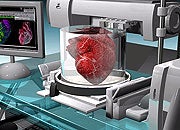
Bioengineers use advancements in stem cell therapy to grow red and white cells for human blood. Meanwhile, a breakthrough in 3D printing: scientists print blood vessels and say that human organs may be next.
Plus, implanting electronic grids to repair neural pathways. Future prosthetics wired to the brain may allow paralyzed limbs to move.
We begin with the story of the scientist who discovered the bacteria that caused tuberculosis, and the famous author who revealed that his cure for TB was a sham.
Guests:
Thomas Goetz – Author of The Remedy: Robert Koch, Arthur Conan Doyle, and the Quest to Cure Tuberculosis
Jose Carmena – Neuroscientist and biomedical engineer at the University of California, Berkeley; co-director of the Berkeley-UCSF Center for Neural Engineering and Prostheses
William Murphy -Bioengineer and co-director of the Stem Cell and Regenerative Medicine Center, University of Wisconsin, Madison
Ali Khademhosseini – Bioengineer, Harvard Medical School, Brigham and Woman’s Hospital
Learn more about your ad choices. Visit megaphone.fm/adchoices
More from Big Picture Science
Over a hundred years ago two famous men met for a séance. One, the creator of an exceedingly rational pipe-smoking fictional detective, and the other, a showman who amazed audiences with feats of esca…
As their name suggests, “forever chemicals” have extraordinary staying power. When these nearly indestructible compounds find their way into our soil and water, they don’t break down for hundreds or t…
We can now follow where Monarch butterflies go when they leave our gardens with tiny sensors that track their impressive 3,000-mile migrations from Canada to Mexico. The significant challenges that th…
Carbon dioxide is more than an industrial pollutant driving climate change. The gas also played a pivotal part in the dramatic story of the beginning of all life. Starting in the ocean depths, dissolv…
How did scientists learn to peer inside the atom? In this preview from the BBC's In Our Time, physicist Harry Cliff tells the story of the birth of the particle accelerator, from Ernest Rutherford's c…