
Radical Cosmology
About this episode
(repeat) 400 years ago, some ideas about the cosmos were too scandalous to mention. When the Dominican friar Giordano Bruno suggested that planets existed outside our Solar System, the Catholic Inquisition had him arrested, jailed, and burned at the stake for heresy.
Today, we have evidence of thousands of planets orbiting other stars. Our discovery of extrasolar planets has dramatically changed ideas about the possibility for life elsewhere in the universe.
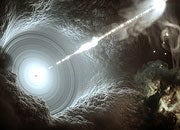
Modern theories about the existence of the ghostly particles called neutrinos or of collapsed stars with unfathomable gravity (black holes), while similarly incendiary, didn’t prompt arrest, of course. Neutrinos and black holes were arresting ideas because they came decades before we had the means to prove their existence.
Hear about scientific ideas that came before their time and why extrasolar planets, neutrinos, and black holes are now found on the frontiers of astronomical research.
Guests:
Alberto Martínez – Professor of history, University of Texas, Austin, and author of Burned Alive: Giordano Bruno, Galileo & the Inquisition
Anne Schukraft – Associate scientist, Fermilab National Accelerator Laboratory
Ephraim Fischbach – Professor of physics and astronomy, Purdue University
Chris Impey – Professor of astronomy, University of Arizona, and author of Einstein’s Monsters: The Life and Times of Black Holes
Learn more about your ad choices. Visit megaphone.fm/adchoices
More from Big Picture Science
Over a hundred years ago two famous men met for a séance. One, the creator of an exceedingly rational pipe-smoking fictional detective, and the other, a showman who amazed audiences with feats of esca…
As their name suggests, “forever chemicals” have extraordinary staying power. When these nearly indestructible compounds find their way into our soil and water, they don’t break down for hundreds or t…
We can now follow where Monarch butterflies go when they leave our gardens with tiny sensors that track their impressive 3,000-mile migrations from Canada to Mexico. The significant challenges that th…
Carbon dioxide is more than an industrial pollutant driving climate change. The gas also played a pivotal part in the dramatic story of the beginning of all life. Starting in the ocean depths, dissolv…
How did scientists learn to peer inside the atom? In this preview from the BBC's In Our Time, physicist Harry Cliff tells the story of the birth of the particle accelerator, from Ernest Rutherford's c…