
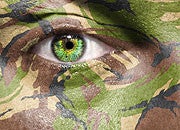
On Defense
About this episode
The military is a dangerous calling. But technology can help out, so researchers are constantly trying to make soldiers safer. Writer Mary Roach investigates how scientists studying so-called human factors are protecting troops from such aggressive foes as heat, noise, and fatigue. She also learns how bad odors were once considered a secret weapon.
And while soldiers have long used camouflage to help them blend in, insects may be the original masters of disguise. A discovery in fossilized amber shows that a variety of bugs employed D.I.Y. camouflaging tricks 100 million years ago.
But where is the defense race headed? The top-secret branch of the Pentagon whose job is to make tomorrow happen today has some ideas. A reporter shares DARPA’s plan for augmented super-soldiers.
Plus, do we always need a technological boost to stay safe? Find out how your innate chemical defense system protects you. It’s an adrenaline rush!
Guests:
Mary Roach - Science reporter, author of “Grunt: The Curious Science of Humans at War”
Michael Engel – Entomologist, invertebrate paleontologist, University of Kansas, and senior curator of its Natural History Museum
Annie Jacobsen – Journalist, author of The Pentagon’s Brain: An Uncensored History of DARPA, America’s Top-Secret Military Research Agency
Brian Hoffman – Professor of medicine, Harvard Medical School, author of Adrenaline
Learn more about your ad choices. Visit megaphone.fm/adchoices
More from Big Picture Science
Over a hundred years ago two famous men met for a séance. One, the creator of an exceedingly rational pipe-smoking fictional detective, and the other, a showman who amazed audiences with feats of esca…
As their name suggests, “forever chemicals” have extraordinary staying power. When these nearly indestructible compounds find their way into our soil and water, they don’t break down for hundreds or t…
We can now follow where Monarch butterflies go when they leave our gardens with tiny sensors that track their impressive 3,000-mile migrations from Canada to Mexico. The significant challenges that th…
Carbon dioxide is more than an industrial pollutant driving climate change. The gas also played a pivotal part in the dramatic story of the beginning of all life. Starting in the ocean depths, dissolv…
How did scientists learn to peer inside the atom? In this preview from the BBC's In Our Time, physicist Harry Cliff tells the story of the birth of the particle accelerator, from Ernest Rutherford's c…