
On a Collision Course
About this episode
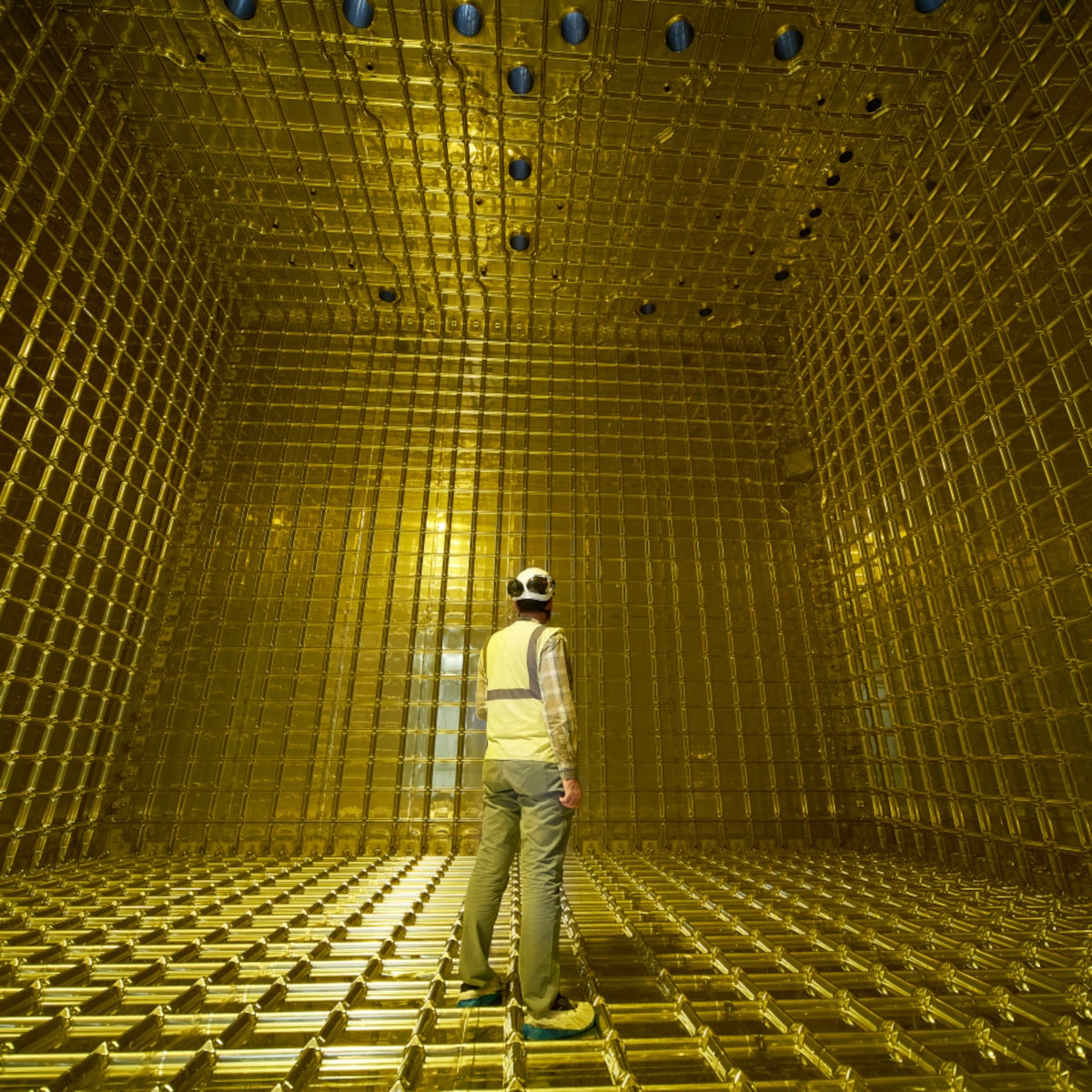
Breakthroughs around the detection of cosmic neutrinos — the “ghost” particles that may reveal why matter, not antimatter, fills the universe — recently earned a physicist the Nobel Prize in Physics. But one group of neutrino hunters isn’t waiting for supernovae to churn up these high-energy particles. A massive new experiment that spans three states will create neutrinos and fire them into liquid argon to better understand their mysterious behavior. And after the better part of a century, scientists may finally have glimpsed the primary component of nearly all matter: dark matter. Are we close to understanding what it is? Finally, we glimpse the proton-smashing at the Large Hadron Collider as it hints at undiscovered physics and puts a stress test on the Standard Model.
Guests:
Kate Shaw – experimental particle physicist at the University of Sussex who works on the Deep Underground Neutrino Experiment, DUNE
Kimberly Palladino – astrophysicist, professor of physics at the University of Oxford, and the project scientist for LUX- ZEPLIN an international collaboration searching for dark matter
Harry Cliff – particle physicist at the University of Cambridge and a researcher with the LHCb experiment at the Large Hadron Collider at CERN
You can get early access to ad-free versions of every episode by joining us on Patreon. Thanks for your support!
Big Picture Science is part of the Airwave Media podcast network. Please contact [email protected] to inquire about advertising on Big Picture Science.
Learn more about your ad choices. Visit megaphone.fm/adchoices
More from Big Picture Science
Over a hundred years ago two famous men met for a séance. One, the creator of an exceedingly rational pipe-smoking fictional detective, and the other, a showman who amazed audiences with feats of esca…
As their name suggests, “forever chemicals” have extraordinary staying power. When these nearly indestructible compounds find their way into our soil and water, they don’t break down for hundreds or t…
We can now follow where Monarch butterflies go when they leave our gardens with tiny sensors that track their impressive 3,000-mile migrations from Canada to Mexico. The significant challenges that th…
Carbon dioxide is more than an industrial pollutant driving climate change. The gas also played a pivotal part in the dramatic story of the beginning of all life. Starting in the ocean depths, dissolv…
How did scientists learn to peer inside the atom? In this preview from the BBC's In Our Time, physicist Harry Cliff tells the story of the birth of the particle accelerator, from Ernest Rutherford's c…