
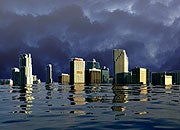
New Water Worlds
About this episode
(repeat) The seas are rising. It’s no longer a rarity to see kayakers paddling through downtown Miami. By century’s end, the oceans could be anywhere from 2 to 6 feet higher, threatening millions of people and property. But humans once knew how to adapt to rising waters. As high water threatens to drown our cities, can we learn do it again.
Hear stories of threatened land: submerged Florida suburbs, the original sunken city (Venice), and the U.S. East Coast, where anthropologists rush to catalogue thousands of low-lying historical and cultural sites in harm’s way, including Jamestown, Virginia and ancient Native American sites.
But also, stories of ancient adaptability: from the First American tribes of the Colusa in South Florida to the ice age inhabitants of Doggerland. And, modern approaches to staying dry: stilt houses, seawalls, and floating cities.
Guests:
Jeff Goodell– Journalist and author of “The Water Will Come: Rising Seas, Sinking Cities, and the Remaking of the Civilized World”
Brian Fagan– Archaeologist and Emeritus Professor of Anthropology, University of California Santa Barbara, and author of many books including “The Attacking Ocean: the Past, Present, and Future of Rising Sea Levels”
David Anderson– Professor of Anthropology, University of Tennessee. His team’s PLOS ONE paper is “Sea-level rise and archaeological site destruction.” His DINAA site can be used to generate maps of where people were living in the past, up to ca. 15,000 years ago.
Learn more about your ad choices. Visit megaphone.fm/adchoices
More from Big Picture Science
Over a hundred years ago two famous men met for a séance. One, the creator of an exceedingly rational pipe-smoking fictional detective, and the other, a showman who amazed audiences with feats of esca…
As their name suggests, “forever chemicals” have extraordinary staying power. When these nearly indestructible compounds find their way into our soil and water, they don’t break down for hundreds or t…
We can now follow where Monarch butterflies go when they leave our gardens with tiny sensors that track their impressive 3,000-mile migrations from Canada to Mexico. The significant challenges that th…
Carbon dioxide is more than an industrial pollutant driving climate change. The gas also played a pivotal part in the dramatic story of the beginning of all life. Starting in the ocean depths, dissolv…
How did scientists learn to peer inside the atom? In this preview from the BBC's In Our Time, physicist Harry Cliff tells the story of the birth of the particle accelerator, from Ernest Rutherford's c…