
NASA or What?
About this episode
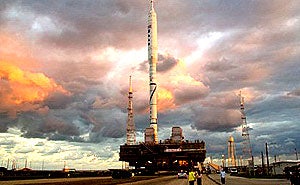
“Making space for everyone” could be NASA’s motto. But as commercial spaceships get ready to blast off, that populist idea is being tested. Space cowboys in the private sector say they’re the ones who can provide unfettered access to space, for tourists and scientists alike.
Meet a scientist who already has a ticket to ride on SpaceShip Two and discover what he hopes to learn about asteroids during his five minutes of weightlessness.
Plus, NASA in motion: it’s back to the moon as the GRAIL mission probes the interior of our lovely lunar satellite. Also, can you dig it? The rover Curiosity can. It’s headed to Mars to hunt for clues to alien life … with a jackhammer.
Also, as the Hubble Space Telescope shuts down, the James Webb Space Telescope revs up. Or does it? The telescope is designed to study the birth of galaxies and hunt for evidence of water on far away worlds. But will Congress pull the plug?
Guests:
James Oberg - former Space Shuttle Mission Control engineer, and space expert
Maria Zuber - Planetary scientist, Massachusetts Institute of Technology and Principal Investigator of NASA’s GRAIL mission
Joy Crisp - Geologist at NASA’s Jet Propulsion Laboratory and Principal Investigator on the Mars Science Laboratory, Curiosity
Massimo Stiavelli - Astronomer at the Space Science Telescope Institute, and Project Scientist for the James Webb Space Telescope
Dan Durda - Planetary scientist, Southwest Research Institute, Boulder, Colorado
More about the Next Generation Suborbital Researchers Conference
Descripción en español
Learn more about your ad choices. Visit megaphone.fm/adchoices
More from Big Picture Science
Over a hundred years ago two famous men met for a séance. One, the creator of an exceedingly rational pipe-smoking fictional detective, and the other, a showman who amazed audiences with feats of esca…
As their name suggests, “forever chemicals” have extraordinary staying power. When these nearly indestructible compounds find their way into our soil and water, they don’t break down for hundreds or t…
We can now follow where Monarch butterflies go when they leave our gardens with tiny sensors that track their impressive 3,000-mile migrations from Canada to Mexico. The significant challenges that th…
Carbon dioxide is more than an industrial pollutant driving climate change. The gas also played a pivotal part in the dramatic story of the beginning of all life. Starting in the ocean depths, dissolv…
How did scientists learn to peer inside the atom? In this preview from the BBC's In Our Time, physicist Harry Cliff tells the story of the birth of the particle accelerator, from Ernest Rutherford's c…