
Nano Nano
About this episode
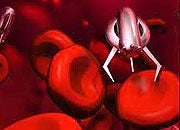
Think small to solve big problems. That, in a nutshell, is the promise of nanotechnology. In this barely visible world, batteries charge 100 times faster and drugs go straight to their targets in the body. Discover some of these nano breakthroughs and how what you can’t see can help you…
…or hurt you? What if tiny machines turn out to be nothing but trouble? We’ll look at the health and safety risks of nanotech.
Plus, scaling up in science fiction: why a Godzilla-sized insect is fun, but just doesn’t fly.
Guests:
Bill Flounders - executive director of the Marvell Nanofabrication Laboratory at the University of California at Berkeley
Joseph DeSimone - professor of chemistry at the University of North Carolina at Chapel Hill and chemical engineering at North Carolina State University
David Guston - political scientist at Arizona State University where he directs The Center for Nanotechnology in Society
Stan Williams - Senior Fellow and founding director of the Information and Quantum Systems Lab at Hewlett-Packard
Michael LaBarbera - Professor in organismal biology, anatomy and geophysical sciences, University of Chicago
Descripción en español
First released February 21 2011
Learn more about your ad choices. Visit megaphone.fm/adchoices
More from Big Picture Science
Over a hundred years ago two famous men met for a séance. One, the creator of an exceedingly rational pipe-smoking fictional detective, and the other, a showman who amazed audiences with feats of esca…
As their name suggests, “forever chemicals” have extraordinary staying power. When these nearly indestructible compounds find their way into our soil and water, they don’t break down for hundreds or t…
We can now follow where Monarch butterflies go when they leave our gardens with tiny sensors that track their impressive 3,000-mile migrations from Canada to Mexico. The significant challenges that th…
Carbon dioxide is more than an industrial pollutant driving climate change. The gas also played a pivotal part in the dramatic story of the beginning of all life. Starting in the ocean depths, dissolv…
How did scientists learn to peer inside the atom? In this preview from the BBC's In Our Time, physicist Harry Cliff tells the story of the birth of the particle accelerator, from Ernest Rutherford's c…