
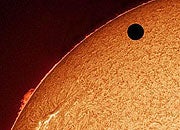
Mass Transits
About this episode
On June 5, our sister planet Venus will slowly slide across the face of the sun. This will be the last transit of Venus until 2117, so there’s no subsequent chance to observe this celestial spectacular for anyone alive today.
Join us for a special episode devoted to this rare event. Two centuries ago, nations were locked in a race to be the first to measure the Venus transit. From the first observation by the “father” of British astronomy to Captain Cook’s Tahitian expedition in the 18th century, meet the pioneers who were trying to nail down the scale of the cosmos
Plus, tips for observing the 2012 transit … how the Kepler spacecraft uses transits to detect Earth-like worlds … and could there be life floating in Venusian clouds?
Guests:
Jay Pasachoff - Astronomer, Williams College
Peter Aughton - Astronomer and author of The Transit of Venus: The Brief, Brilliant Life of Jeremiah Horrocks, Father of British Astronomy
Nick Lomb - Former Curator of Astronomy, Sydney Observatory, and author of Transit of Venus: 1631 to the Present
Andrea Wulf - Author of Chasing Venus: The Race to Measure the Heavens
David Grinspoon - Curator of Astrobiology at the Denver Museum of Nature and Science
Jon Jenkins - Lead analyst with the Kepler Mission and senior scientist with the SETI Institute
Descripción en español
Learn more about your ad choices. Visit megaphone.fm/adchoices
More from Big Picture Science
Over a hundred years ago two famous men met for a séance. One, the creator of an exceedingly rational pipe-smoking fictional detective, and the other, a showman who amazed audiences with feats of esca…
As their name suggests, “forever chemicals” have extraordinary staying power. When these nearly indestructible compounds find their way into our soil and water, they don’t break down for hundreds or t…
We can now follow where Monarch butterflies go when they leave our gardens with tiny sensors that track their impressive 3,000-mile migrations from Canada to Mexico. The significant challenges that th…
Carbon dioxide is more than an industrial pollutant driving climate change. The gas also played a pivotal part in the dramatic story of the beginning of all life. Starting in the ocean depths, dissolv…
How did scientists learn to peer inside the atom? In this preview from the BBC's In Our Time, physicist Harry Cliff tells the story of the birth of the particle accelerator, from Ernest Rutherford's c…