
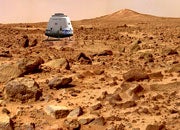
Mars-Struck
About this episode
You love to travel. But would you if doing so meant never coming home? The private company Mars One says it will land humans on the Red Planet by 2026, but is only offering passengers one-way tickets. Hundreds of thousands of people volunteered to go.
Meet a young woman who made the short list, and hear why she’s ready to be Mars-bound. Also, why microbes could be hiding in water trapped in the planet’s rocks. And, how a wetter, better Mars lost its atmosphere and became a dry and forbidding place.
Plus, why Kim Stanley Robinson, author of a famous trilogy about colonizing and terraforming Mars, thinks that the current timeline for going to the planet is unrealistic.
Guests:
• Laurel Kaye – A senior in the physics department at Duke University
• Alfonso Davila – Senior scientist at the SETI Institute
• Stephen Brecht – Physicist and president of the Bay Area Research Group
• Kim Stanley Robinson – Hugo Award-winning science Fiction author of the Mars trilogy: Red Mars (Mars Trilogy), Green Mars (Mars Trilogy), Blue Mars (Mars Trilogy)
Learn more about your ad choices. Visit megaphone.fm/adchoices
More from Big Picture Science
Over a hundred years ago two famous men met for a séance. One, the creator of an exceedingly rational pipe-smoking fictional detective, and the other, a showman who amazed audiences with feats of esca…
As their name suggests, “forever chemicals” have extraordinary staying power. When these nearly indestructible compounds find their way into our soil and water, they don’t break down for hundreds or t…
We can now follow where Monarch butterflies go when they leave our gardens with tiny sensors that track their impressive 3,000-mile migrations from Canada to Mexico. The significant challenges that th…
Carbon dioxide is more than an industrial pollutant driving climate change. The gas also played a pivotal part in the dramatic story of the beginning of all life. Starting in the ocean depths, dissolv…
How did scientists learn to peer inside the atom? In this preview from the BBC's In Our Time, physicist Harry Cliff tells the story of the birth of the particle accelerator, from Ernest Rutherford's c…