
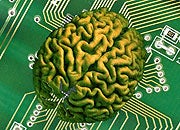
Living Computers
About this episode
It’s the most dramatic technical development of recent times: Teams of people working for decades to produce a slow-motion revolution we call computing. As these devices become increasingly powerful, we recall that a pioneer from the nineteenth century – Ada Lovelace, a mathematician and Lord Byron’s daughter – said they would never surpass human ability. Was she right?
We consider the near-term future of computing as the Internet of Things is poised to link everything together, and biologists adopt the techniques of information science to program living cells.
Plus: What’s your favorite sci-fi computer?
Guests:
Walter Isaacson – President and CEO of the Aspen Institute and the author of The Innovators: How a Group of Hackers, Geniuses, and Geeks Created the Digital Revolution
Christopher Voigt – Bioengineer at MIT
Andy Ihnatko – Technology journalist
André Bormanis – Writer, screenwriter, Star Trek
John Barrett – Electronic engineer, NIMBUS Centre for Embedded Systems Research at the Cork Institute of Technology, Ireland
First released December 7, 2014.
Learn more about your ad choices. Visit megaphone.fm/adchoices
More from Big Picture Science
Over a hundred years ago two famous men met for a séance. One, the creator of an exceedingly rational pipe-smoking fictional detective, and the other, a showman who amazed audiences with feats of esca…
As their name suggests, “forever chemicals” have extraordinary staying power. When these nearly indestructible compounds find their way into our soil and water, they don’t break down for hundreds or t…
We can now follow where Monarch butterflies go when they leave our gardens with tiny sensors that track their impressive 3,000-mile migrations from Canada to Mexico. The significant challenges that th…
Carbon dioxide is more than an industrial pollutant driving climate change. The gas also played a pivotal part in the dramatic story of the beginning of all life. Starting in the ocean depths, dissolv…
How did scientists learn to peer inside the atom? In this preview from the BBC's In Our Time, physicist Harry Cliff tells the story of the birth of the particle accelerator, from Ernest Rutherford's c…