
Land on the Run
About this episode
Hang on to your globe. One day it’ll be a collector’s item. The arrangement of continents you see today is not what it once was, nor what it will be tomorrow. Thank plate tectonics.
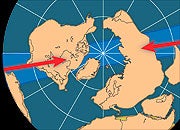
Now evidence suggests that the crowding together of all major land masses into one supercontinent – Pangaea, as it’s called – is a phenomenon that’s happened over and over during Earth’s history. And it will happen again. Meet our future supercontinent home, Amasia, and learn what it will look like.
Meanwhile, as California waits for the Big One, geologists discover that major earthquakes come in clusters. Also, our planet is not the only solar system body with tectonic activity. Icy Europa is a mover and shaker too.
And why is land in the western part of the U.S. literally rising up? Mystery solved!
Guests:
John Dvorak – Geologist, author of Earthquake Storms: The Fascinating History and Volatile Future of the San Andreas Fault
Adrian Borsa – Geophysicist, Scripps Institute of Oceanography, University of California, San Diego
Ross Mitchell – Geologist and post-doctoral scholar at the California Institute of Technology
Simon Kattenhorn – Structural geologist and a planetary geologist who did his work on Europa while at the University of Idaho
First released September 29, 2014
Learn more about your ad choices. Visit megaphone.fm/adchoices
More from Big Picture Science
Over a hundred years ago two famous men met for a séance. One, the creator of an exceedingly rational pipe-smoking fictional detective, and the other, a showman who amazed audiences with feats of esca…
As their name suggests, “forever chemicals” have extraordinary staying power. When these nearly indestructible compounds find their way into our soil and water, they don’t break down for hundreds or t…
We can now follow where Monarch butterflies go when they leave our gardens with tiny sensors that track their impressive 3,000-mile migrations from Canada to Mexico. The significant challenges that th…
Carbon dioxide is more than an industrial pollutant driving climate change. The gas also played a pivotal part in the dramatic story of the beginning of all life. Starting in the ocean depths, dissolv…
How did scientists learn to peer inside the atom? In this preview from the BBC's In Our Time, physicist Harry Cliff tells the story of the birth of the particle accelerator, from Ernest Rutherford's c…