
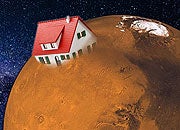
It's Habitable Forming
About this episode
(repeat) There’s evidence for a subsurface lake on Mars, and scientists are excitedly using the “h” word. Could the Red Planet be habitable, not billions of years ago, but today? While we wait – impatiently – for a confirmation of this result, we review the recipe for habitable alien worlds. For example, the moon Titan has liquid lakes on its surface. Could they be filled with Titanites?
Dive into a possible briny, underground lake on Mars … protect yourself from the methane-drenched rain on a moon of Saturn … and cheer on the missed-it-by-that-much planets, asteroids Ceres and Vesta.
Also, do tens of billions of potentially habitable extrasolar planets mean that Earth is not unique?
Guests:
Nathalie Cabrol – Planetary scientist, Director of the Carl Sagan Center for the Study of Life in the Universe at the SETI Institute
Jack Holt – Geophysicist, Lunar and Planetary Laboratory, University of Arizona
Jani Radebaugh – Planetary scientist and professor of geology, Brigham Young University
Marc Rayman – Mission Director and Chief Engineer of NASA’s Dawn Mission
Phil Plait – Astronomer, blogger, and widely known as the Bad Astronomer
Learn more about your ad choices. Visit megaphone.fm/adchoices
More from Big Picture Science
Over a hundred years ago two famous men met for a séance. One, the creator of an exceedingly rational pipe-smoking fictional detective, and the other, a showman who amazed audiences with feats of esca…
As their name suggests, “forever chemicals” have extraordinary staying power. When these nearly indestructible compounds find their way into our soil and water, they don’t break down for hundreds or t…
We can now follow where Monarch butterflies go when they leave our gardens with tiny sensors that track their impressive 3,000-mile migrations from Canada to Mexico. The significant challenges that th…
Carbon dioxide is more than an industrial pollutant driving climate change. The gas also played a pivotal part in the dramatic story of the beginning of all life. Starting in the ocean depths, dissolv…
How did scientists learn to peer inside the atom? In this preview from the BBC's In Our Time, physicist Harry Cliff tells the story of the birth of the particle accelerator, from Ernest Rutherford's c…