
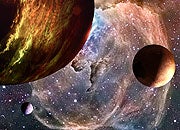
Imagining Planets
About this episode
Pluto, we hardly knew ye. Well, not anymore! Until recently, Pluto and Mars were respectively the least-known and best-known planet-sized bodies in our Solar System. Thanks to the New Horizons spacecraft, our picture of Pluto has changed from a featureless dot to a place where we can name the geologic features. And with rovers and orbiters surveying the red planet, we now know much more about Mars than our parents ever did. Examining our planetary backyard has provided insight into the trillion other planets in our galaxy.
Dive into a mountain lake and trek though the driest desert on Earth with a scientist who’s had not one but two near-fatal incidents in these extreme environments. Find out what questions compel her to keep returning.
And scientists on the New Horizons mission remember why the nail-biting Pluto flyby almost failed at the last minute. Find out what surprises Pluto offered and what the mission might uncover as it heads to its next, outer solar-system target.
Also, from Earth-like planets to super Earths and water worlds: a tour of some of Kepler’s most intriguing extrasolar planets.
Guests:
Nathalie Cabrol- Planetary scientist at the SETI Institute.
Alan Stern- Principal Investigator for NASA’s New Horizon mission, and co-author with David Grinspoon of “Chasing New Horizons: Inside the Epic First Mission to Pluto.”
David Grinspoon- Senior scientist at the Planetary Science Institute, and co-author with Alan Stern of “Chasing New Horizons: Inside the Epic First Mission to Pluto.”
Jack Lissauer- Space scientist at the NASA Ames Research Center.
Learn more about your ad choices. Visit megaphone.fm/adchoices
More from Big Picture Science
Over a hundred years ago two famous men met for a séance. One, the creator of an exceedingly rational pipe-smoking fictional detective, and the other, a showman who amazed audiences with feats of esca…
As their name suggests, “forever chemicals” have extraordinary staying power. When these nearly indestructible compounds find their way into our soil and water, they don’t break down for hundreds or t…
We can now follow where Monarch butterflies go when they leave our gardens with tiny sensors that track their impressive 3,000-mile migrations from Canada to Mexico. The significant challenges that th…
Carbon dioxide is more than an industrial pollutant driving climate change. The gas also played a pivotal part in the dramatic story of the beginning of all life. Starting in the ocean depths, dissolv…
How did scientists learn to peer inside the atom? In this preview from the BBC's In Our Time, physicist Harry Cliff tells the story of the birth of the particle accelerator, from Ernest Rutherford's c…