
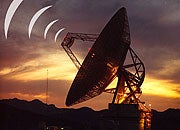
How to Talk to Aliens
About this episode
"Dear E.T. …” So far, so good. But now what? Writing is never easy, but what if your task was to craft a message to aliens living elsewhere in the universe, and your prose would represent all humankind? Got writer’s block yet?
What to say to the aliens was the focus of a recent conference in which participants shifted their attentions away from listening for extraterrestrial signals to transmitting some. In this show, we report on the “Communicating Across the Cosmos” conference held at the SETI Institute in December 2014.
Find out what scientists think we should say. Also, how archeology could help us craft messages to an unfamiliar culture. Plus, why journalists might be well-suited to writing the message. And, a response to Stephen Hawking’s warning that attempting to contact aliens is too dangerous.
Guests:
Douglas Vakoch – Director of interstellar message composition, SETI Institute
Paul Wason – Archaeologist, anthropologist and vice president for the life sciences and genetics program at the Templeton Foundation
Al Harrison – Emeritus professor of psychology, University of California, Davis
Morris Jones – Journalist and space analyst in Sydney, Australia
Shari Wells-Jensen – Professor of English, Bowling Green State University
First released January 12, 2015.
Learn more about your ad choices. Visit megaphone.fm/adchoices
More from Big Picture Science
Over a hundred years ago two famous men met for a séance. One, the creator of an exceedingly rational pipe-smoking fictional detective, and the other, a showman who amazed audiences with feats of esca…
As their name suggests, “forever chemicals” have extraordinary staying power. When these nearly indestructible compounds find their way into our soil and water, they don’t break down for hundreds or t…
We can now follow where Monarch butterflies go when they leave our gardens with tiny sensors that track their impressive 3,000-mile migrations from Canada to Mexico. The significant challenges that th…
Carbon dioxide is more than an industrial pollutant driving climate change. The gas also played a pivotal part in the dramatic story of the beginning of all life. Starting in the ocean depths, dissolv…
How did scientists learn to peer inside the atom? In this preview from the BBC's In Our Time, physicist Harry Cliff tells the story of the birth of the particle accelerator, from Ernest Rutherford's c…