
High Moon
About this episode
(repeat) "The moon or bust” is now officially bust. No private company was able to meet the Lunar X Prize challenge, and arrange for a launch by the 2018 deadline. The $30 million award goes unclaimed, but the race to the moon is still on. Find out who wants to go and why this is not your parents’ – or grandparents’ – space race.
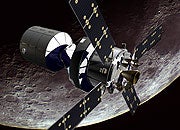
With or without a cash incentive, private companies are still eyeing our cratered companion, hoping to set hardware down on its dusty surface. Meanwhile, while the U.S. waffles about a return to the moon, India and China are sending a second round of robots skyward. And a proposed orbiting laboratory – the Lunar Orbital Platform-Gateway – may literally put scientists over, and around, the moon.
The moon continues to entice sci-fi writers, and Andy Weir’s new novel describes a vibrant lunar colony. Its premise of colonists launched from Kenya is not entirely fiction: the nation is one of many in Africa with space programs.
Guests:
Andy Weir – Author of “The Martian” and, most recently, “Artemis”
Allen Herbert – Vice President of Business Development and Strategy for NanoRacks, LLC and author of an article about emerging space programs in Africa
Greg Schmidt – Deputy director of the Solar System Exploration Research Virtual Institute at NASA Ames Research Center
Jason Crusan – NASA Director of Advanced Exploration Systems for Human Space Flight
Learn more about your ad choices. Visit megaphone.fm/adchoices
More from Big Picture Science
Over a hundred years ago two famous men met for a séance. One, the creator of an exceedingly rational pipe-smoking fictional detective, and the other, a showman who amazed audiences with feats of esca…
As their name suggests, “forever chemicals” have extraordinary staying power. When these nearly indestructible compounds find their way into our soil and water, they don’t break down for hundreds or t…
We can now follow where Monarch butterflies go when they leave our gardens with tiny sensors that track their impressive 3,000-mile migrations from Canada to Mexico. The significant challenges that th…
Carbon dioxide is more than an industrial pollutant driving climate change. The gas also played a pivotal part in the dramatic story of the beginning of all life. Starting in the ocean depths, dissolv…
How did scientists learn to peer inside the atom? In this preview from the BBC's In Our Time, physicist Harry Cliff tells the story of the birth of the particle accelerator, from Ernest Rutherford's c…