
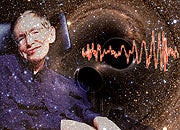
Hawkingravity
About this episode
(repeat) Stephen Hawking felt gravity’s pull. His quest to understand this feeble force spanned his career, and he was the first to realize that black holes actually disappear – slowly losing the mass of everything they swallow in a dull, evaporative glow called Hawking radiation.
But one of gravity’s deepest puzzles defied even his brilliant mind. How can we connect theories of gravity on the large scale to what happens on the very small? The Theory of Everything remains one of the great challenges to physicists.
Also, the latest on deciphering the weirdness of black holes and why the gravitational wave detector LIGO has added colliding neutron stars to its roster of successes.
Plus, a fellow physicist describes Dr. Hawking’s extraordinary deductive abilities and what it was like to collaborate with him. And, a surprise awaits Molly when she meets a local string theorist to discuss his search for the Theory of Everything.
Guests:
Leonard Mlodinow– physicist and author of “The Grand Design” with Stephen Hawking, and most recently, “Elastic: Flexible Thinking in a Time of Change.”
Janna Levin– Physicist and astronomer, Barnard College, Columbia University, and the author of, “Black Hole Blues and Other Songs from Outer Space.”
Richard Camuccio– Graduate research assistant at the University of Texas Rio Grande Valley Center for Gravitational Wave Astronomy, a LIGO collaborator.
Wahltyn Rattray – Grad-student, the University of Texas Rio Grande Valley Center for Gravitational Wave Astronomy.
Raphael Bousso– Physicist, Berkeley Center for Theoretical Physics, University of California-Berkeley.
Learn more about your ad choices. Visit megaphone.fm/adchoices
More from Big Picture Science
Over a hundred years ago two famous men met for a séance. One, the creator of an exceedingly rational pipe-smoking fictional detective, and the other, a showman who amazed audiences with feats of esca…
As their name suggests, “forever chemicals” have extraordinary staying power. When these nearly indestructible compounds find their way into our soil and water, they don’t break down for hundreds or t…
We can now follow where Monarch butterflies go when they leave our gardens with tiny sensors that track their impressive 3,000-mile migrations from Canada to Mexico. The significant challenges that th…
Carbon dioxide is more than an industrial pollutant driving climate change. The gas also played a pivotal part in the dramatic story of the beginning of all life. Starting in the ocean depths, dissolv…
How did scientists learn to peer inside the atom? In this preview from the BBC's In Our Time, physicist Harry Cliff tells the story of the birth of the particle accelerator, from Ernest Rutherford's c…