
Exoplanets
About this episode
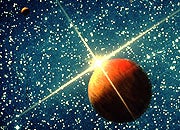
You may be unique, but is your home planet? NASA’s Kepler spacecraft has uncovered thousands of planetary candidates, far far beyond our solar system. Some may be habitable and possibly even Earth-like. But now a failure in its steering apparatus may bring an abrupt end to this pioneering telescope’s search for new worlds.
But Kepler has a massive legacy of data still to be studied. Many new worlds will undoubtedly be found in these data. Hear why the astronomer who has discovered the greatest number of exoplanets is hopeful about the hunt for alien life, and meet the next generation of planet-hunting instruments.
Also, “Weird worlds? That was our idea!” Sci-fi writers lay claim to the first musings on exotic planetary locales. And a biographer of Magellan and Columbus describes the dangerous hunt for new worlds five centuries ago.
Guests:
Charlie Sobeck – Engineer, deputy project manager, Kepler Mission, NASA Ames Research Center
Geoff Marcy – Astronomer, University of California, Berkeley
Dan Clery – Deputy news editor, European office of Science
Laurence Bergreen – author of Voyage to Mars, Columbus: The Four Voyages, 1492-1504, Over the Edge of the World: Magellan’s Terrifying Circumnavigation of the Globe (P.S.)
Robert J. Sawyer – Hugo Award-winning author; most recently of Red Planet Blues
Descripción en español
Learn more about your ad choices. Visit megaphone.fm/adchoices
More from Big Picture Science
Over a hundred years ago two famous men met for a séance. One, the creator of an exceedingly rational pipe-smoking fictional detective, and the other, a showman who amazed audiences with feats of esca…
As their name suggests, “forever chemicals” have extraordinary staying power. When these nearly indestructible compounds find their way into our soil and water, they don’t break down for hundreds or t…
We can now follow where Monarch butterflies go when they leave our gardens with tiny sensors that track their impressive 3,000-mile migrations from Canada to Mexico. The significant challenges that th…
Carbon dioxide is more than an industrial pollutant driving climate change. The gas also played a pivotal part in the dramatic story of the beginning of all life. Starting in the ocean depths, dissolv…
How did scientists learn to peer inside the atom? In this preview from the BBC's In Our Time, physicist Harry Cliff tells the story of the birth of the particle accelerator, from Ernest Rutherford's c…