
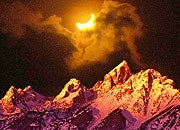
Eclipsing All Other Shows
About this episode
They say that the experience of watching a total eclipse is so profound, you’re not the same afterward. If life-changing events are your thing and you’re in the lower 48 states on August 21st, let us help you make the most of viewing the Great American Solar Eclipse.
Learn the basics of where to be and what to bring, even on short notice. No eclipse glasses? Find out why a kitchen colander is an excellent Plan B.
Also, the strange behavior of animals and private jet pilots during an eclipse. The latter is making the FAA sweat.
Plus, how 1878 eclipse fever inspired Thomas Edison and astronomer Maria Mitchell, and what was at stake for them scientifically. And today, with astronauts able to view the Sun from space, what new science can we still learn by eclipse expeditions on Earth?
And, NASA turns up the heat on solar studies with a probe to within a hair’s breadth of the Sun.
Guests:
David Baron - Author of “American Eclipse: A Nation’s Epic Race to Catch the Shadow of the Moon and Win the Glory of the World.”
Andrew Fraknoi - Chair of the Astronomy Department, Foothill College. His latest book, for children: “When the Sun Goes Dark.”
Jay Pasachoff - Professor of Astronomy, Williams College, chair of the International Astronomical Union Working Group on Solar Eclipses.
Madhulika Guhathakurta - Astrophysicist, NASA Heliophysics Science Division and Program Scientist for the Solar Probe Plus mission.
Learn more about your ad choices. Visit megaphone.fm/adchoices
More from Big Picture Science
Over a hundred years ago two famous men met for a séance. One, the creator of an exceedingly rational pipe-smoking fictional detective, and the other, a showman who amazed audiences with feats of esca…
As their name suggests, “forever chemicals” have extraordinary staying power. When these nearly indestructible compounds find their way into our soil and water, they don’t break down for hundreds or t…
We can now follow where Monarch butterflies go when they leave our gardens with tiny sensors that track their impressive 3,000-mile migrations from Canada to Mexico. The significant challenges that th…
Carbon dioxide is more than an industrial pollutant driving climate change. The gas also played a pivotal part in the dramatic story of the beginning of all life. Starting in the ocean depths, dissolv…
How did scientists learn to peer inside the atom? In this preview from the BBC's In Our Time, physicist Harry Cliff tells the story of the birth of the particle accelerator, from Ernest Rutherford's c…