
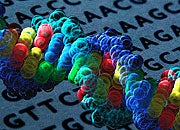
DNA: Nature's Hard Drive
About this episode
(Repeat) The biotech tool CRISPR lets us do more than shuffle genes. Researchers have embedded an animated GIF into a living organism’s DNA, proving that the molecule is a great repository for information. This has encouraged speculation that DNA could be used by aliens to send messages.
Meanwhile, nature has seized on this powerful storage system in surprising ways. Scientists have learned that the 98% of our genome – once dismissed as “junk” – contains valuable genetic treasure. Find out what project ENCODE is learning about the “dark genome.”
Plus, how viruses became the original stealth coders, inserting their DNA into ancient bacteria and eventually leading to the development of CRISPR technology. Discover the potential of this powerful tool, from curing disease to making pig organs transplant-friendly, and the possible dark side of quick-and-easy gene editing.
Guests:
Paul Davies- Director of the Beyond Center for Fundamental Concepts in Science at Arizona State University
Yin Shen- Assistant professor, Department of Neurology, Institute for Human Genetics, University of California – San Francisco, member of ENCODE team
Sam Sternberg- Assistant professor, Department of Biochemistry and Molecular Biophysics, Columbia University, and co-author of “A Crack in Creation: Gene Editing and the Unthinkable Power to Control Evolution”
Hank Greely- Director, Center for Law and the Biosciences; Chair of the Steering Committee of the Center for Biomedical Ethics; and Director, Stanford Program in Neuroscience and Society
Learn more about your ad choices. Visit megaphone.fm/adchoices
More from Big Picture Science
Over a hundred years ago two famous men met for a séance. One, the creator of an exceedingly rational pipe-smoking fictional detective, and the other, a showman who amazed audiences with feats of esca…
As their name suggests, “forever chemicals” have extraordinary staying power. When these nearly indestructible compounds find their way into our soil and water, they don’t break down for hundreds or t…
We can now follow where Monarch butterflies go when they leave our gardens with tiny sensors that track their impressive 3,000-mile migrations from Canada to Mexico. The significant challenges that th…
Carbon dioxide is more than an industrial pollutant driving climate change. The gas also played a pivotal part in the dramatic story of the beginning of all life. Starting in the ocean depths, dissolv…
How did scientists learn to peer inside the atom? In this preview from the BBC's In Our Time, physicist Harry Cliff tells the story of the birth of the particle accelerator, from Ernest Rutherford's c…