
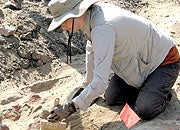
Digging Our Past
About this episode
What’s past is prologue. For centuries, researchers have studied buried evidence – bones, teeth, or artifacts – to learn about murky human history, or even to investigate vanished species. But today’s hi-tech forensics allow us to analyze samples dug from the ground faster and at a far more sophisticated level.
First, the discovery of an unknown species of dinosaur that changes our understanding of the bizarre beasts that once roamed North America.
And then some history that’s more recent: two projects that use the tools of modern chemistry and anthropology to deepen our understanding of the slave trade.
Plus, an anthropologist on an evolutionary habit that is strange to some, but nonetheless common all over the world: the urge to eat dirt.
Guests:
• Scott Sampson – Paleontologist at the Denver Museum of Nature and Science and author of Dinosaur Odyssey: Fossil Threads in the Web of Life
• Fatimah Jackson – Biologist, anthropologist, University of North Carolina, Chapel Hill, director of the Cobb Lab at Howard University, and advisor to EUROTAST
• Joseph Jones – Biological anthropologist, visiting assistant professor at the College of William and Mary, researcher on the African Burial Ground Project
• Sera Young – Research scientist, division of Nutritional Sciences, Cornell University, and author of Craving Earth: Understanding Pica—the Urge to Eat Clay, Starch, Ice, and Chalk
First released August 12, 2013.
Learn more about your ad choices. Visit megaphone.fm/adchoices
More from Big Picture Science
Over a hundred years ago two famous men met for a séance. One, the creator of an exceedingly rational pipe-smoking fictional detective, and the other, a showman who amazed audiences with feats of esca…
As their name suggests, “forever chemicals” have extraordinary staying power. When these nearly indestructible compounds find their way into our soil and water, they don’t break down for hundreds or t…
We can now follow where Monarch butterflies go when they leave our gardens with tiny sensors that track their impressive 3,000-mile migrations from Canada to Mexico. The significant challenges that th…
Carbon dioxide is more than an industrial pollutant driving climate change. The gas also played a pivotal part in the dramatic story of the beginning of all life. Starting in the ocean depths, dissolv…
How did scientists learn to peer inside the atom? In this preview from the BBC's In Our Time, physicist Harry Cliff tells the story of the birth of the particle accelerator, from Ernest Rutherford's c…