
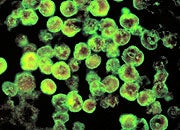
Blame it on Bacterio
About this episode
Think small! Microbes are tinier than the dot at the end of this sentence, yet they can make humans sicker than dogs, dogs sicker than humans, jump from animal to human and keep scientists guessing when and where the next disease will appear.
Discover how doctors diagnosed one man’s mysterious infection, the role that animals play as hosts for disease, and why the rate of emerging diseases is increasing worldwide.
Also, why your kitchen is a biosafety hazard, and how the Human Microbiome Project will tally all the microbes on – and in - you.
Plus, the extreme places on Earth where microbes thrive and what it suggests for the existence of alien life. And, how one strain of bacteria helped a farmer grow a pumpkin the weight of a small car!
Guests:
Peter Hudson - Biologist, Director of Life Sciences at Penn State University
Peter Krause - Senior research scientist at the Yale School of Public Health
Durland Fish - Epidemiologist at the Yale School of Public Health. Information on his Lyme disease app
David Relman - Stanford University microbiologist and infectious disease clinician
Erich Fleming - Biologist, SETI Institute
O. Peter Snyder - Hospitality Institute of Technology and Management
John Raeside - Oakland, California
Frances Raeside - Oakland, California
Jennifer Kate Arnold - Infectious Disease Clinic, Kaiser Permanente Medical Group
Dave Stelts - Farmer, head of the Great Pumpkin Commonwealth
Neil Anderson - Owner, president of Reforestation Technologies International. Find retail products.
Descripción en español
Learn more about your ad choices. Visit megaphone.fm/adchoices
More from Big Picture Science
Over a hundred years ago two famous men met for a séance. One, the creator of an exceedingly rational pipe-smoking fictional detective, and the other, a showman who amazed audiences with feats of esca…
As their name suggests, “forever chemicals” have extraordinary staying power. When these nearly indestructible compounds find their way into our soil and water, they don’t break down for hundreds or t…
We can now follow where Monarch butterflies go when they leave our gardens with tiny sensors that track their impressive 3,000-mile migrations from Canada to Mexico. The significant challenges that th…
Carbon dioxide is more than an industrial pollutant driving climate change. The gas also played a pivotal part in the dramatic story of the beginning of all life. Starting in the ocean depths, dissolv…
How did scientists learn to peer inside the atom? In this preview from the BBC's In Our Time, physicist Harry Cliff tells the story of the birth of the particle accelerator, from Ernest Rutherford's c…