
Bare Bones
About this episode
You may not feel that your skeleton does very much. But without it you’d be a limp bag of protoplasm, unable to move. And while you may regard bones as rigid and inert, they are living tissue.
Bones are also time capsules, preserving much of your personal history. Find out how evolutionary biologists, forensic anthropologists, and even radiation scientists read them.
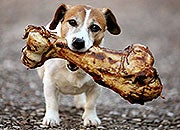
And why won’t your dog stop gnawing on that bone?
Guests:
Brian Switek – Pen name of Riley Black, Author of “Skeleton Keys: the Secret Life of Bone.”
Ann Ross – Forensic anthropologist at North Carolina State University. Her lab is the North Carolina Office of the Chief Medical Examiner for the North Carolina Department of Health and Human Services.
Stanley Coren – Professor emeritus of psychology at the University of British Columbia, and author of many books about canine behavior including, “Why Does My Dog Act That Way?”
Doug Brugge – Professor and chair of the Department of Public Health Sciences at the University of Connecticut School of Medicine
Learn more about your ad choices. Visit megaphone.fm/adchoices
More from Big Picture Science
Over a hundred years ago two famous men met for a séance. One, the creator of an exceedingly rational pipe-smoking fictional detective, and the other, a showman who amazed audiences with feats of esca…
As their name suggests, “forever chemicals” have extraordinary staying power. When these nearly indestructible compounds find their way into our soil and water, they don’t break down for hundreds or t…
We can now follow where Monarch butterflies go when they leave our gardens with tiny sensors that track their impressive 3,000-mile migrations from Canada to Mexico. The significant challenges that th…
Carbon dioxide is more than an industrial pollutant driving climate change. The gas also played a pivotal part in the dramatic story of the beginning of all life. Starting in the ocean depths, dissolv…
How did scientists learn to peer inside the atom? In this preview from the BBC's In Our Time, physicist Harry Cliff tells the story of the birth of the particle accelerator, from Ernest Rutherford's c…