
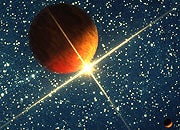
A Sudden Change in Planets
About this episode
A planet is a planet is a planet. Unless it’s Pluto – then it’s a dwarf planet. But even then it’s a planet, according to experts. So what was behind the unpopular re-classification of Pluto by astronomers, and were they justified?
As the New Horizons spacecraft closes in on this small body, one planetary scientist says that this dwarf planet could be more typical of planets than Mars, Mercury, and Saturn. And that our solar system has not 8 or even 9 planets, but 900.
Also, meet a type of planet that’s surprisingly commonplace, although we don’t have one in our solar system: super Earths. Could they harbor life?
And the DAWN mission continues its visit to the two most massive residents of the asteroid belt: Vesta and Ceres. Discover what these proto-planets may reveal to us about the early solar system.
Guests:
Alan Stern – Planetary scientist, Southwest Research Institute, Principal Investigator of the New Horizons mission
Marc Rayman – DAWN Mission chief engineer and mission director
David Stevenson – Professor of planetary science at CalTech
Rebekah Dawson – Astronomer, postdoctoral fellow at the University of California, Berkeley
David Eicher – Editor-in-chief, Astronomy Magazine
Descripción en español
Learn more about your ad choices. Visit megaphone.fm/adchoices
More from Big Picture Science
Over a hundred years ago two famous men met for a séance. One, the creator of an exceedingly rational pipe-smoking fictional detective, and the other, a showman who amazed audiences with feats of esca…
As their name suggests, “forever chemicals” have extraordinary staying power. When these nearly indestructible compounds find their way into our soil and water, they don’t break down for hundreds or t…
We can now follow where Monarch butterflies go when they leave our gardens with tiny sensors that track their impressive 3,000-mile migrations from Canada to Mexico. The significant challenges that th…
Carbon dioxide is more than an industrial pollutant driving climate change. The gas also played a pivotal part in the dramatic story of the beginning of all life. Starting in the ocean depths, dissolv…
How did scientists learn to peer inside the atom? In this preview from the BBC's In Our Time, physicist Harry Cliff tells the story of the birth of the particle accelerator, from Ernest Rutherford's c…