
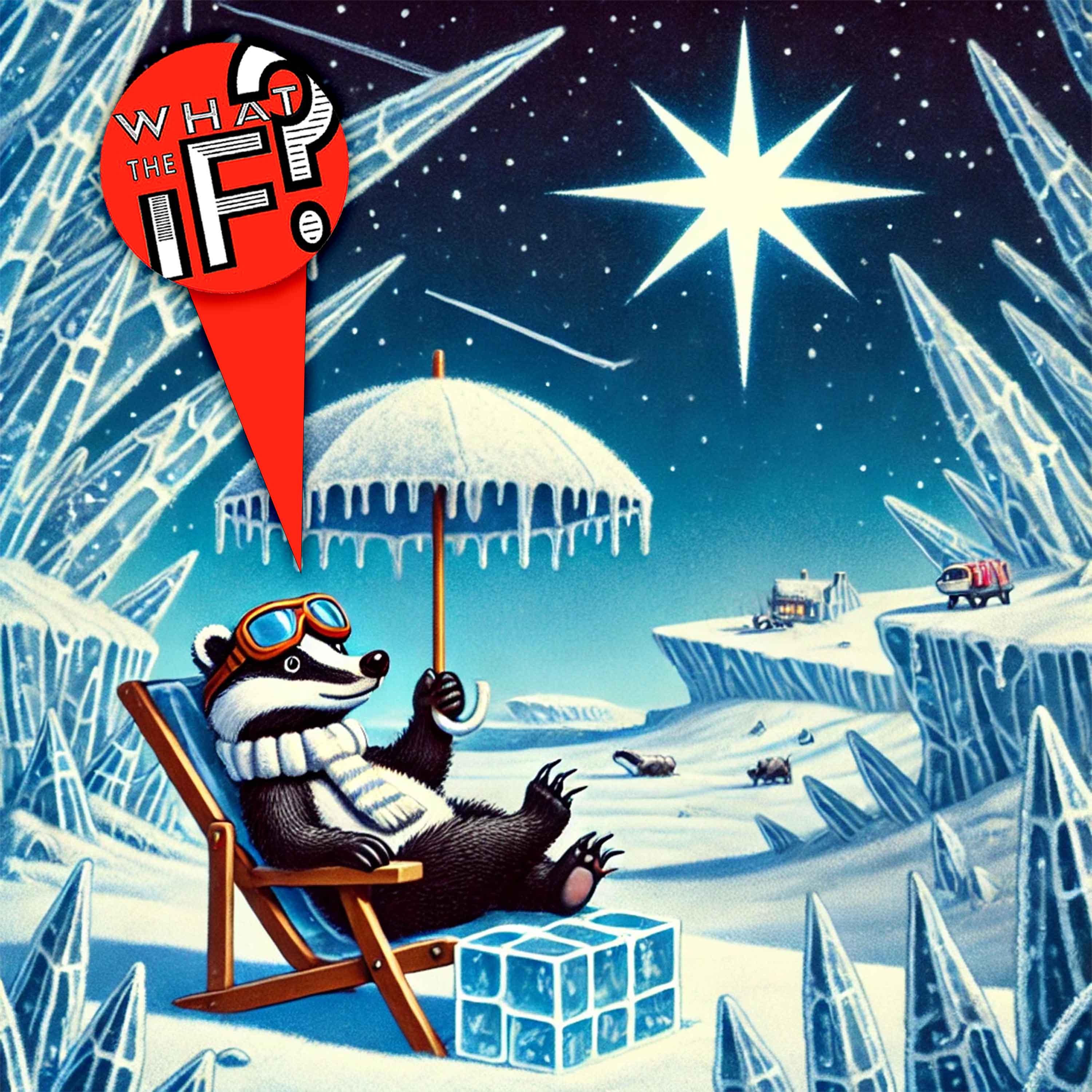
White Dwarf SUN!
About this episode
Based on new research reported by Matt Williams in Universe Today, an Earth-like planet orbiting a white dwarf star 4,000 light years away might offer a preview of our own solar system's distant future. Journey through the dramatic transformation as our Sun expands into a massive red giant, consuming Mercury and Venus before shedding its outer layers and shrinking to a tiny white dwarf. Explore how Earth might survive this cosmic evolution, migrating to a more distant orbit in a permanently frozen state where ice badgers could theoretically evolve to thrive in the dim light of our shrunken star.
Read the article in Universe Today: https://www.universetoday.com/168746/an-earth-like-planet-around-a-dead-sun-provides-some-reassurance-about-the-future-of-earth/#more-168746
Find out more about Gaby's science fiction short story!
Here are the links for the anthology. The physical copy can be ordered here : https://www.neonhemlock.com/books/luminescent-machinations-queer-tales-of-monumental-invention
The ebook can be ordered here: https://www.neonhemlock.com/ebooks/luminescent-machinations-queer-tales-of-monumental-invention
More from What The If?
What the if "medieval" were the highest compliment? University of Pennsylvania historian of science Elly Truitt is our guide on a mission to rescue the Middle Ages' reputation. You'll meet scholars 90…
A City Inside A LAVA TUBE! by Philip Shane, Matt Stanley, Gabrielle Paniccia
Picture a world where we all grow a suit of armor right out of our skin, so heavy that if we tried to swim, we'd sink like a rock! In this episode you'll learn how some ants turn the carbon dioxide in…
Happy Halloween! This week we're getting spooky and asking: what the if vampires were real, and scientists got to study them up close? You'll learn why our bodies slowly lose the knack for swapping ol…
Picture a world where you skip lunch, step outside, and let your skin soak up a meal from the sun. In this episode we explore that fanciful scenario. Along the way you'll learn how plants first got th…