
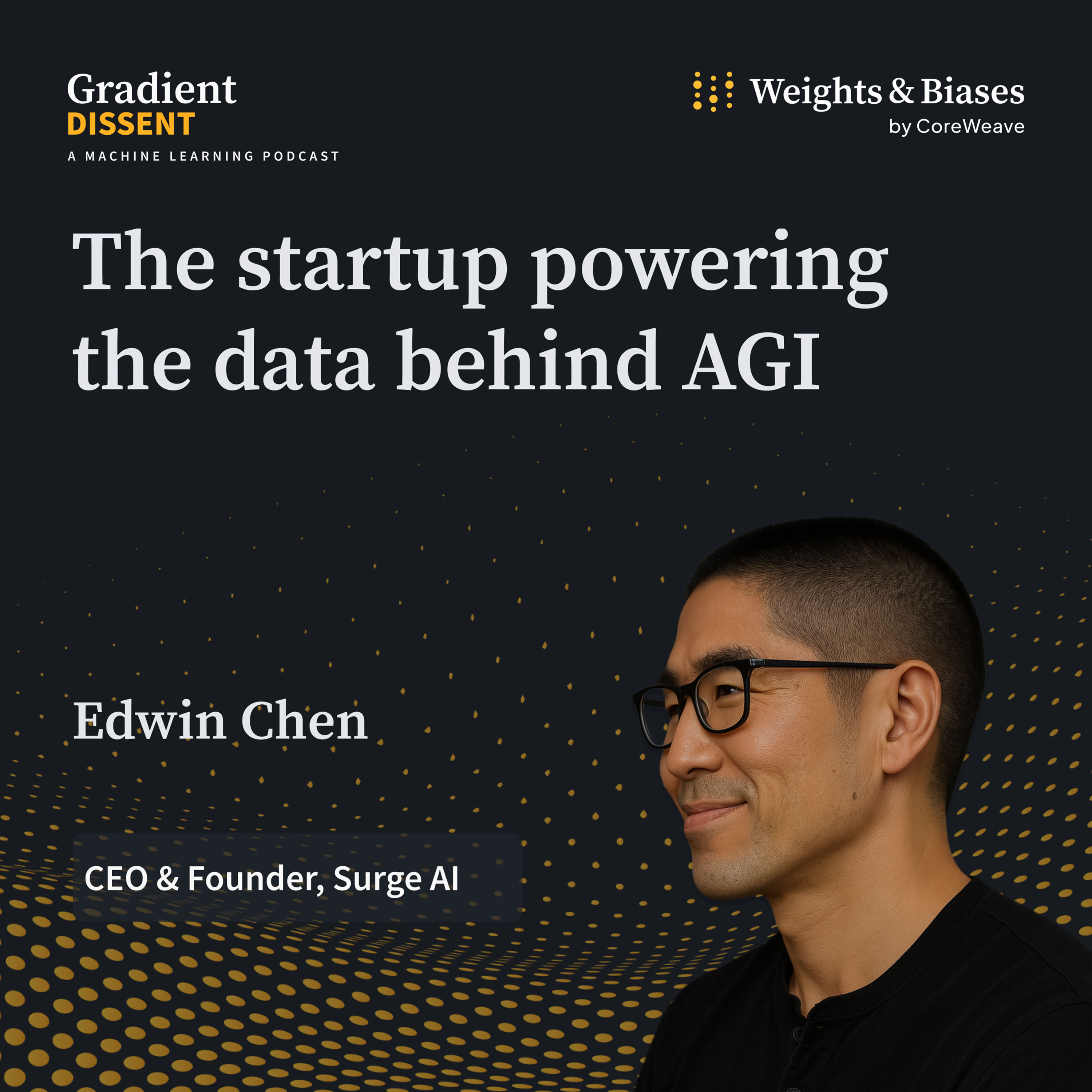
Episode 130 · Season 1
The Startup Powering The Data Behind AGI
About this episode
In this episode of Gradient Dissent, Lukas Biewald talks with the CEO & founder of Surge AI, the billion-dollar company quietly powering the next generation of frontier LLMs. They discuss Surge's origin story, why traditional data labeling is broken, and how their research-focused approach is reshaping how models are trained.
You’ll hear why inter-annotator agreement fails in high-complexity tasks like poetry and math, why synthetic data is often overrated, and how Surge builds rich RL environments to stress-test agentic reasoning. They also go deep on what kinds of data will be critical to future progress in AI—from scientific discovery to multimodal reasoning and personalized alignment.
It’s a rare, behind-the-scenes look into the world of high-quality data generation at scale—straight from the team most frontier labs trust to get it right.
Timestamps:
00:00 – Intro: Who is Edwin Chen?
03:40 – The problem with early data labeling systems
06:20 – Search ranking, clickbait, and product principles
10:05 – Why Surge focused on high-skill, high-quality labeling
13:50 – From Craigslist workers to a billion-dollar business
16:40 – Scaling without funding and avoiding Silicon Valley status games
21:15 – Why most human data platforms lack real tech
25:05 – Detecting cheaters, liars, and low-quality labelers
28:30 – Why inter-annotator agreement is a flawed metric
32:15 – What makes a great poem? Not checkboxes
36:40 – Measuring subjective quality rigorously
40:00 – What types of data are becoming more important
44:15 – Scientific collaboration and frontier research data
47:00 – Multimodal data, Argentinian coding, and hyper-specificity
50:10 – What's wrong with LMSYS and benchmark hacking
53:20 – Personalization and taste in model behavior
56:00 – Synthetic data vs. high-quality human data
Follow Weights & Biases:
https://twitter.com/weights_biases
https://www.linkedin.com/company/wandb
More from Gradient Dissent: Conversations on AI
Can today's power grid handle the explosive growth of AI data centers? Tesla Alum Drew Baglino, now founder & CEO of Heron Power, doesn't think so. In this episode, he joins Lukas Biewald to talk abou…
Should American companies be worried about Chinese open-source AI models? Lin Qiao, CEO of Fireworks, doesn't think so. In this episode, she joins Lukas Biewald to talk about why she believes the indu…
"We are going to switch from the problem in AI being that nothing works to the problem being that everything works." Dan Klein has been studying language models for over two decades and is now a profe…
Samuel Rodriques left physics because there were no unsolved problems left. Instead, he built an AI scientist named Kosmos to cure every disease, solve aging, and map the human brain. In this episode:…
"Every vehicle is capable of driverless operation. That's clearly the steady state of where we're going." Wayve started in a rented house in Cambridge with $1.5M, a car in the garage, and an aim to in…