
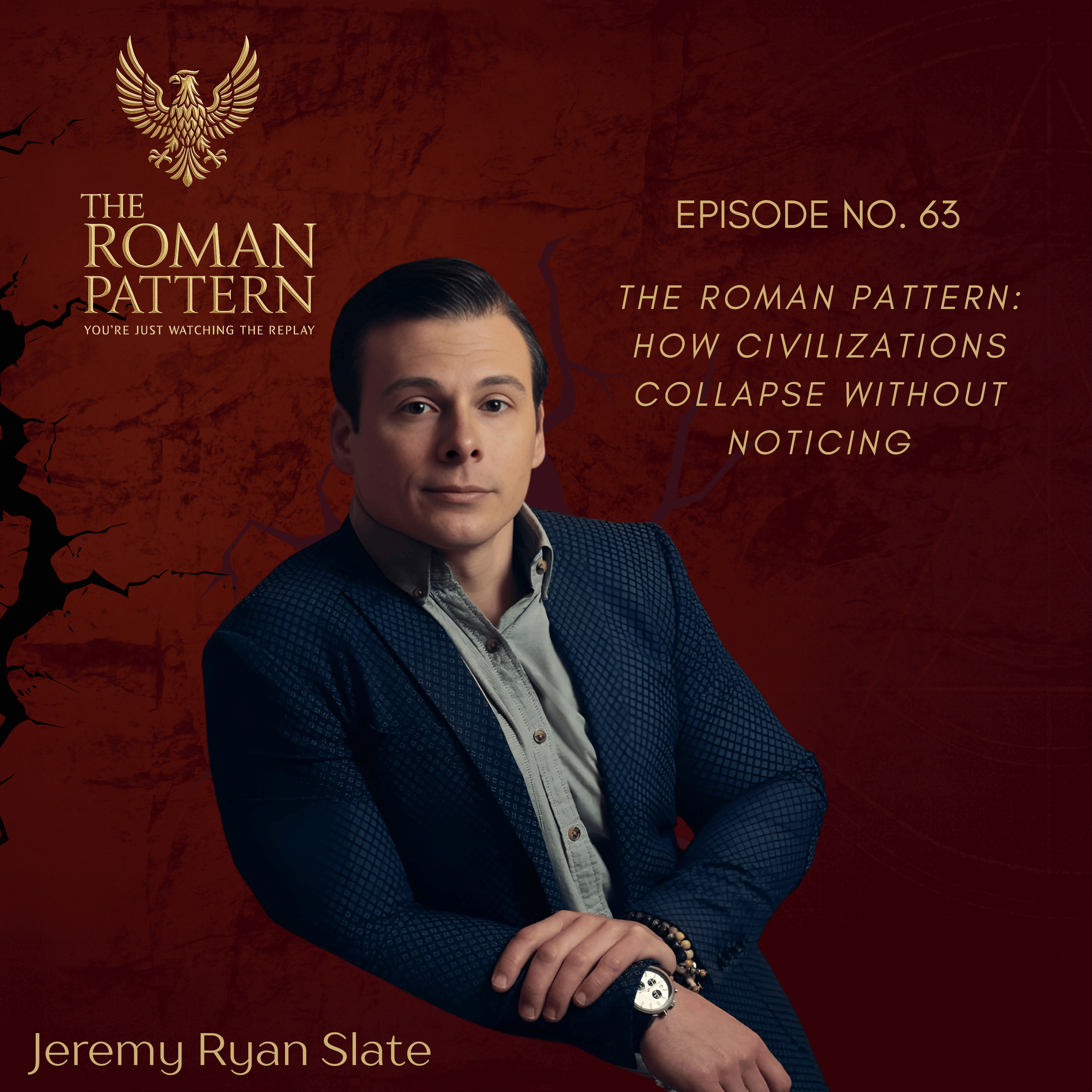
Episode 63 · Season 1
The Roman Pattern: How Civilizations Collapse Without Noticing
About this episode
Most people think collapse is an explosion.
A wall falls. A city burns. A single date on a timeline.
But that’s almost never how it happens.
Rome didn’t “fall in 476.” That’s the lie.
Rome faded — slowly — through a series of rational “fixes” that hollowed the system from the inside.
In this flagship episode, I explain what I call **The Roman Pattern**:
When a civilization gets stressed, it adapts… and those adaptations repeat in predictable ways.
Rome’s pressure points were always the same:
1) Money (debasement → inflation → trust collapse)
2) Borders & people (migration stress → deals → fragmentation)
3) Power (emergency authority → permanent rule by decree)
And here’s the twist:
Rome survived again and again — by becoming something else.
Until “Roman” stopped meaning anything real.
If you want to spot collapse signals in real-time — and understand what today is rhyming with — this is the foundation.
Subscribe for more episodes breaking down the patterns of empire decline.
👇 QUESTION FOR YOU:
Are we living in our own “Third Century”… or are we already closer to Rome in 470?
More from The Jeremy Ryan Slate Show
The fall of the Roman Republic, told in full, from Cincinnatus giving up the dictatorship in 458 BC to Hannibal's slaughter at Cannae, the Gracchi, Marius and Sulla, Spartacus, Crassus and Pompey, Jul…
Scipio Africanus beat Hannibal at Zama in 202 BC, and within about fifteen years the Roman Republic he saved was putting his family on trial while he lived out his last years at Liternum, unwilling to…
The fall of the Roman Republic took about ninety years, from the killing of Tiberius Gracchus in 133 BC to the Second Triumvirate and the proscriptions of 43 BC, and most of the rules that ended it we…
Lucius Quinctius Cincinnatus was named dictator of Rome in 458 BC to rescue a consular army trapped by the Aequi on Mount Algidus, and he gave up absolute power on the 16th day of a six-month term, wi…
Edward Bernays (1891–1995), the Vienna-born nephew of Sigmund Freud, spent most of the twentieth century teaching American business and government how to manufacture public opinion. He is usually call…