
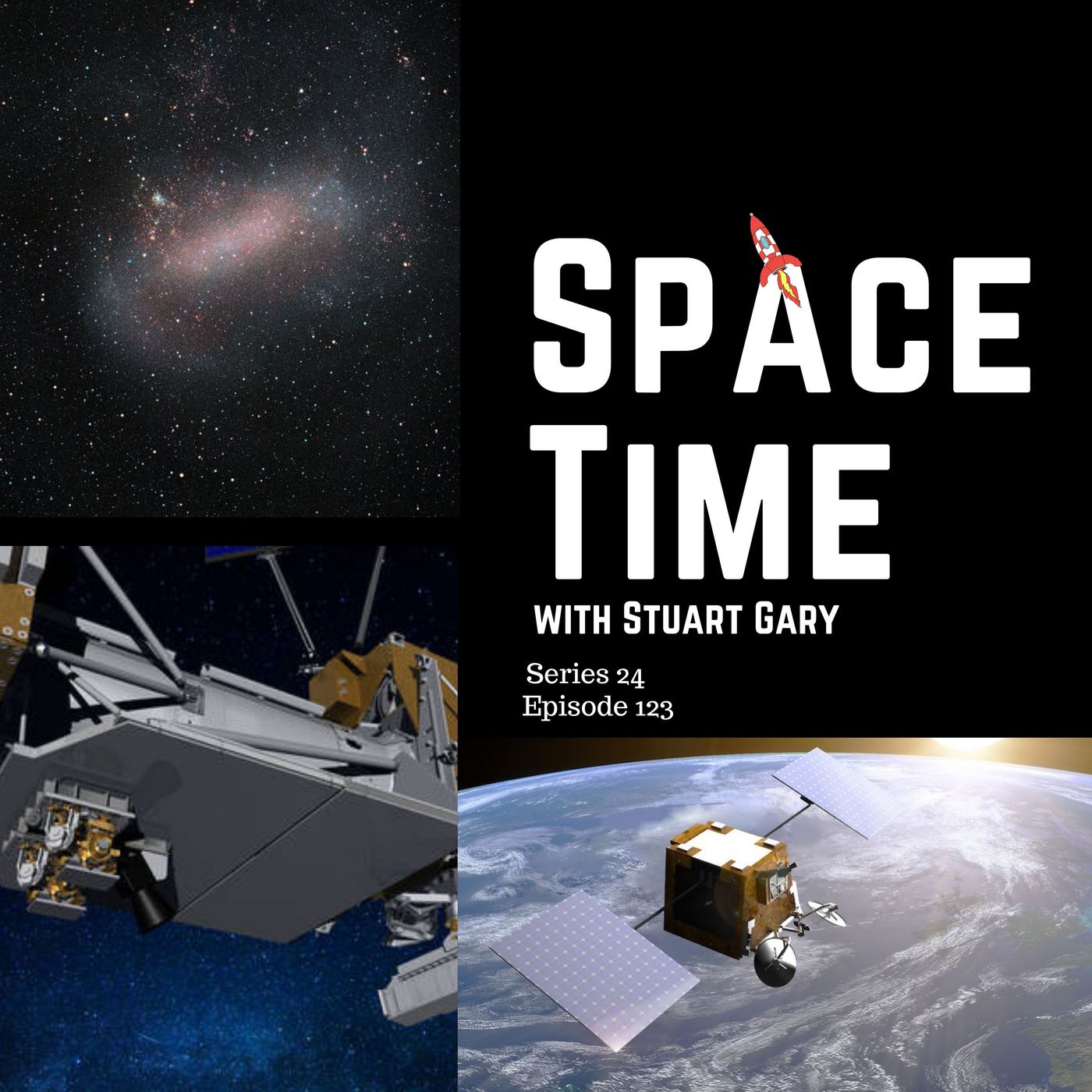
The Large Magellanic Cloud Cannibalizing Smaller Galaxies
About this episode
SpaceTime Series 24 Episode 123
*The Large Magellanic Cloud cannibalizing smaller galaxies
Scientists have confirmed that the Large Magellanic Cloud has been cannibalizing smaller galaxies. Astronomers already knew that large galaxies like the Milky Way grow by merging with or cannibalizing smaller galaxies. But now a report in the journal Nature has shown that a small satellite dwarf galaxy like the Large Magellanic Cloud has in turn absorbed an even smaller galaxy in its vicinity.
*NASA’s first test of optical communications technology
NASA is about to test a new optical laser communications system in space for the first time. The Laser Communications Relay Demonstration is gearing up for launch next month with the payload now fully integrated into its host spacecraft and ready for its final testing before being lofted into orbit.
*One Web’s constellation passes the halfway mark
One Web have launched another 36 broadband internet satellites into orbit.
*The Science Report
Discovery of the first fossil evidence of modern human remains from the Pleistocene in Sulawesi.
The US State Department provides details on America’s current nuclear weapons stockpile.
A new study suggests horses were first domesticated in the Volga-Don region of Russia.
Skeptic's guide to schadenfreude over COVID deniers who get sick.
For more SpaceTime and show links: https://linktr.ee/biteszHQ
If you love this podcast, please get someone else to listen too. Thank you…
Your support is needed...
SpaceTime is an independently produced podcast (we are not funded by any government grants, big organisations or companies), and we’re working towards becoming a completely listener supported show...meaning we can do away with the commercials and sponsors. We figure the time can be much better spent on researching and producing stories for you, rather than having to chase sponsors to help us pay the bills.
That's where you come in....help us reach our first 1,000 subscribers...at that level the show becomes financially viable and bills can be paid without us breaking into a sweat every month. Every little bit helps...even if you could contribute just $1 per month. It all adds up.
By signing up and becoming a supporter at the $5 or more level, you get immediate access to over 240 commercial-free, double, and triple episode editions of SpaceTime plus extended interview bonus content. You also receive all new episodes on a Monday rather than having to wait the week out. Subscribe via Patreon or Supercast (you get a month’s free trial with Supercast to see if it’s really for you or not)....and share in the rewards. Details at Patreon www.patreon.com/spacetimewithstuartgary or Supercast - https://bitesznetwork.supercast.tech/
Details at https://spacetimewithstuartgary.com or www.bitesz.com
Sponsor Details:
This episode is brought to you with the support of NameCheap…cheap domain names is just the beginning of your own online presence. We use them and we love them. Get our special deal…just visit: https://spacetimewithstuartgary.com/namecheap and help support the show.
For more SpaceTime visit https://spacetimewithstuartgary.com (mobile friendly).
For enhanced Show Notes including photos to accompany this episode: https://www.bitesz.com/show/spacetime/blog/
More from SpaceTime with Stuart Gary
Friday SpaceTime 20261127 Series 29 Episode 142 BepiColombo arrives at Mercury After eight years of travelling through the inner Solar System, a gravity assist flyby around the Earth, two around Venus…
Wednesday SpaceTime 20261125 Series 29 Episode 141 China to land a spacecraft on the Jovian Moon Callisto China has officially unveiled plans to attempt humanity’s first-ever landing on one of Jupiter…
Monday SpaceTime 20261123 Series 29 Episode 140 Debris from an ancient stellar merger blast still raining down on Earth A new study has discovered that debris is still raining down on planet Earth fro…
Friday SpaceTime 20261120 Series 29 Episode 139 New clues about origins of the ice giants Uranus and Neptune New study suggests the ice worlds of Uranus and Neptune had very different origins despite…
Wednesday SpaceTime 20261118 Series 29 Episode 138 Voyager 1 spacecraft reaches a full light day away from Earth NASA’s Voyager 1 spacecraft has made history today becoming the first man made object t…