
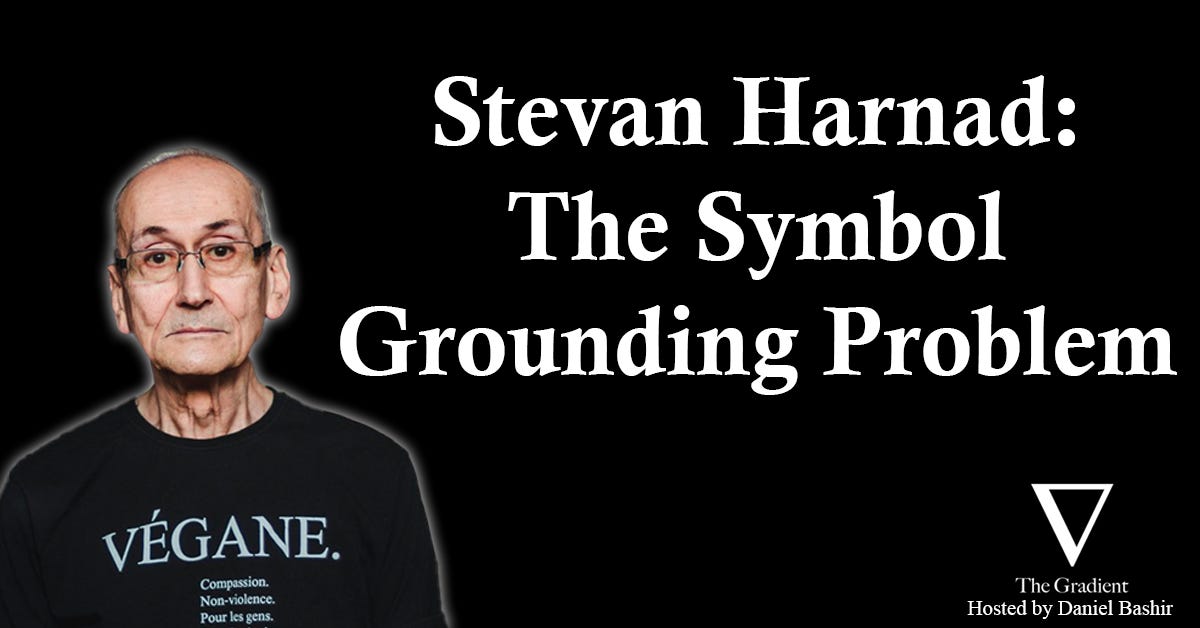
Stevan Harnad: AI's Symbol Grounding Problem
About this episode
In episode 88 of The Gradient Podcast, Daniel Bashir speaks to Professor Stevan Harnad.
Stevan Harnad is professor of psychology and cognitive science at Université du Québec à Montréal, adjunct professor of cognitive science at McGill University, and professor emeritus of cognitive science at the University of Southampton. His research is on category learning, categorical perception, symbol grounding, the evolution of language, and animal and human sentience (otherwise known as “consciousness”). He is also an advocate for open access and an activist for animal rights.
Have suggestions for future podcast guests (or other feedback)? Let us know here or reach us at [email protected]
Subscribe to The Gradient Podcast: Apple Podcasts | Spotify | Pocket Casts | RSSFollow The Gradient on Twitter
Outline:
* (00:00) Intro
* (05:20) Professor Harnad’s background: interests in cognitive psychobiology, editing Behavioral and Brain Sciences
* (07:40) John Searle submits the Chinese Room article
* (09:20) Early reactions to Searle and Prof. Harnad’s role
* (13:38) The core of Searle’s argument and the generator of the Symbol Grounding Problem, “strong AI”
* (19:00) Ways to ground symbols
* (20:26) The acquisition of categories
* (25:00) Pantomiming, non-linguistic category formation
* (27:45) Mathematics, abstraction, and grounding
* (36:20) Symbol manipulation and interpretation language
* (40:40) On the Whorf Hypothesis
* (48:39) Defining “grounding” and introducing the “T3” Turing Test
* (53:22) Turing’s concerns, AI and reverse-engineering cognition
* (59:25) Other Minds, T4 and zombies
* (1:05:48) Degrees of freedom in solutions to the Turing Test, the easy and hard problems of cognition
* (1:14:33) Over-interepretation of AI systems’ behavior, sentience concerns, T3 and evidence sentience
* (1:24:35) Prof. Harnad’s commentary on claims in The Vector Grounding Problem
* (1:28:05) RLHF and grounding, LLMs’ (ungrounded) capabilities, syntactic structure and propositions
* (1:35:30) Multimodal AI systems (image-text and robotic) and grounding, compositionality
* (1:42:50) Chomsky’s Universal Grammar, LLMs and T2
* (1:50:55) T3 and cognitive simulation
* (1:57:34) Outro
Links:
* Professor Harnad’s webpage and skywritings
* Papers:
* Category Induction and Representation
* From Sensorimotor Categories to Grounded Symbols
* Minds, machines and Searle 2
* The Latent Structure of Dictionaries
Get full access to The Gradient at thegradientpub.substack.com/subscribe
More from The Gradient: Perspectives on AI
Episode 144 Happy New Year! This is one of my favorite episodes of the year — for the fourth time, Nathan Benaich and I did our yearly roundup of AI news and advancements, including selections from th…
Episode 143 I spoke with Iason Gabriel about: * Value alignment * Technology and worldmaking * How AI systems affect individuals and the social world Iason is a philosopher and Senior Staff Research S…
Episode 142 Happy holidays! This is one of my favorite episodes of the year — for the third time, Nathan Benaich and I did our yearly roundup of all the AI news and advancements you need to know. This…
Episode 141 I spoke with Professor Philip Goff about: * What a “post-Galilean” science of consciousness looks like * How panpsychism helps explain consciousness and the hybrid cosmopsychist view Enjoy…
Hi everyone! If you’re a new subscriber or listener, welcome. If you’re not new, you’ve probably noticed that things have slowed down from us a bit recently. Hugh Zhang, Andrey Kurenkov and I sat down…