
Episode 508 · Season 1
Spatiotemporal Data Analysis with Rose Yu - #508
About this episode
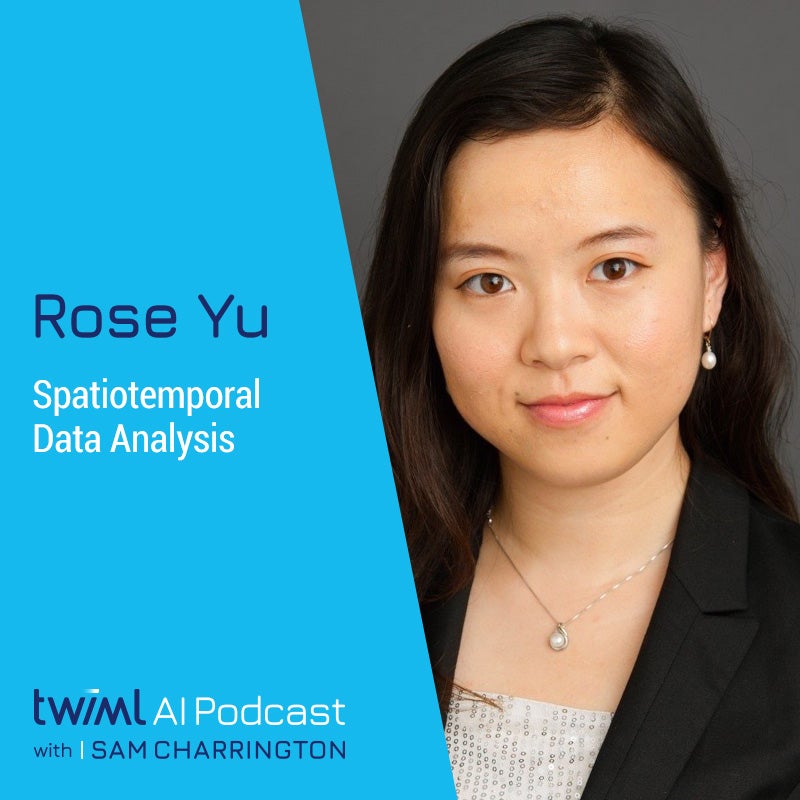
Today we’re joined by Rose Yu, an assistant professor at the Jacobs School of Engineering at UC San Diego.
Rose’s research focuses on advancing machine learning algorithms and methods for analyzing large-scale time-series and spatial-temporal data, then applying those developments to climate, transportation, and other physical sciences. We discuss how Rose incorporates physical knowledge and partial differential equations in these use cases and how symmetries are being exploited. We also explore their novel neural network design that is focused on non-traditional convolution operators and allows for general symmetry, how we get from these representations to the network architectures that she has developed and another recent paper on deep spatio-temporal models.
The complete show note for this episode can be found at twimlai.com/go/508.
More from The TWIML AI Podcast (formerly This Week in Machine Learning & Artificial Intelligence)
In this episode, Thore Graepel, CEO and co-founder of Metis Reasoning and Chair of Machine Learning at UCL, joins us to explore an approach to AI reasoning inspired by his work on AlphaGo. We discuss…
An AI agent can make many model calls to finish a single job. Some need frontier reasoning. Others can run on an open-weight model, and some involve data that has to stay in-house. How do you decide w…
In this episode, Stefano Corazza, head of AI research at Canva, joins us to explore how his team is building custom models and agents around iterative design workflows. We discuss the tradeoffs betwee…
AI can help scientists write code, analyze data, and draft papers. But can it generate the ideas that lead to new discoveries? Richard Socher, former chief scientist at Salesforce, founder of You.com,…
AI agents are becoming accessible to everyone, raising the bar for developers building the next generation of agent products. When capable, general-purpose agents are available out of the box, differe…