
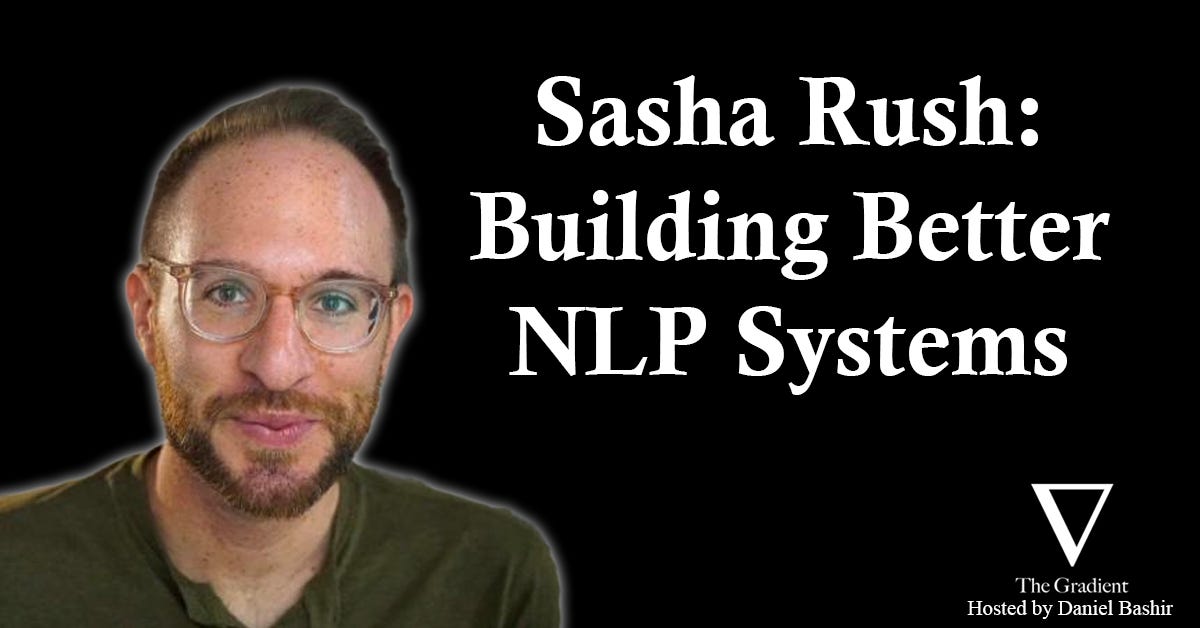
Sasha Rush: Building Better NLP Systems
About this episode
In episode 113 of The Gradient Podcast, Daniel Bashir speaks to Professor Sasha Rush.
Professor Rush is an Associate Professor at Cornell University and a Researcher at HuggingFace. His research aims to develop natural language processing systems that are safe, fast, and controllable. His group is interested primarily in tasks that involve text generation, and they study data-driven probabilistic methods that combine deep-learning based models with probabilistic controls. He is also interested in open-source NLP and deep learning, and develops projects to make deep learning systems safer, clearer, and easier to use.
Have suggestions for future podcast guests (or other feedback)? Let us know here or reach us at [email protected]
Subscribe to The Gradient Podcast: Apple Podcasts | Spotify | Pocket Casts | RSSFollow The Gradient on Twitter
Outline:
* (00:00) Intro
* (01:47) Professor Rush’s background
* (03:23) Professor Rush’s reflections on prior work—importance of learning and inference
* (04:58) How much engineering matters in deep learning, the Rush vs. Frankle Bet
* (07:12) On encouraging and incubating good research
* (10:50) Features of good research environments
* (12:36) 5% bets in Professor Rush’s research: State-Space Models (SSMs) as an alternative to Transformers
* (15:58) SSMs vs. Transformers
* (18:53) Probabilistic Context-Free Grammars—are (P)CFGs worth paying attention to?
* (20:53) Sequence-level knowledge distillation: approximating sequence-level distributions
* (25:08) Pruning and knowledge distillation — orthogonality of efficiency techniques
* (26:33) Broader thoughts on efficiency
* (28:31) Works on prompting
* (28:58) Prompting and In-Context Learning
* (30:05) Thoughts on mechanistic interpretability
* (31:25) Multitask prompted training enables zero-shot task generalization
* (33:48) How many data points is a prompt worth?
* (35:13) Directions for controllability in LLMs
* (39:11) Controllability and safety
* (41:23) Open-source work, deep learning libraries
* (42:08) A story about Professor Rush’s post-doc at FAIR
* (43:51) The impact of PyTorch
* (46:08) More thoughts on deep learning libraries
* (48:48) Levels of abstraction, PyTorch as an interface to motivate research
* (50:23) Empiricism and research commitments
* (53:32) Outro
Links:
* Research
* Early work / PhD
* Dual Decomposition and LP Relaxations
* Vine Pruning for Efficient Multi-Pass Dependency Parsing
* Improved Parsing and POS Tagging Using Inter-Sentence Dependency Constraints
* Research — interpretable and controllable natural language generation
* Compound Probabilistic Context-Free Grammars for Grammar Induction
* Multitask prompted training enables zero-shot task generalization
* Research — deep generative models
* A Neural Attention Model for Abstractive Sentence Summarization
* Learning Neural Templates for Text Generation
* How many data points is a prompt worth?
* Research — efficient algorithms and hardware for speech, translation, dialogue
* Sequence-Level Knowledge Distillation
* Open-source work
Get full access to The Gradient at thegradientpub.substack.com/subscribe
More from The Gradient: Perspectives on AI
Episode 144 Happy New Year! This is one of my favorite episodes of the year — for the fourth time, Nathan Benaich and I did our yearly roundup of AI news and advancements, including selections from th…
Episode 143 I spoke with Iason Gabriel about: * Value alignment * Technology and worldmaking * How AI systems affect individuals and the social world Iason is a philosopher and Senior Staff Research S…
Episode 142 Happy holidays! This is one of my favorite episodes of the year — for the third time, Nathan Benaich and I did our yearly roundup of all the AI news and advancements you need to know. This…
Episode 141 I spoke with Professor Philip Goff about: * What a “post-Galilean” science of consciousness looks like * How panpsychism helps explain consciousness and the hybrid cosmopsychist view Enjoy…
Hi everyone! If you’re a new subscriber or listener, welcome. If you’re not new, you’ve probably noticed that things have slowed down from us a bit recently. Hugh Zhang, Andrey Kurenkov and I sat down…