
Episode 181 · Season 5
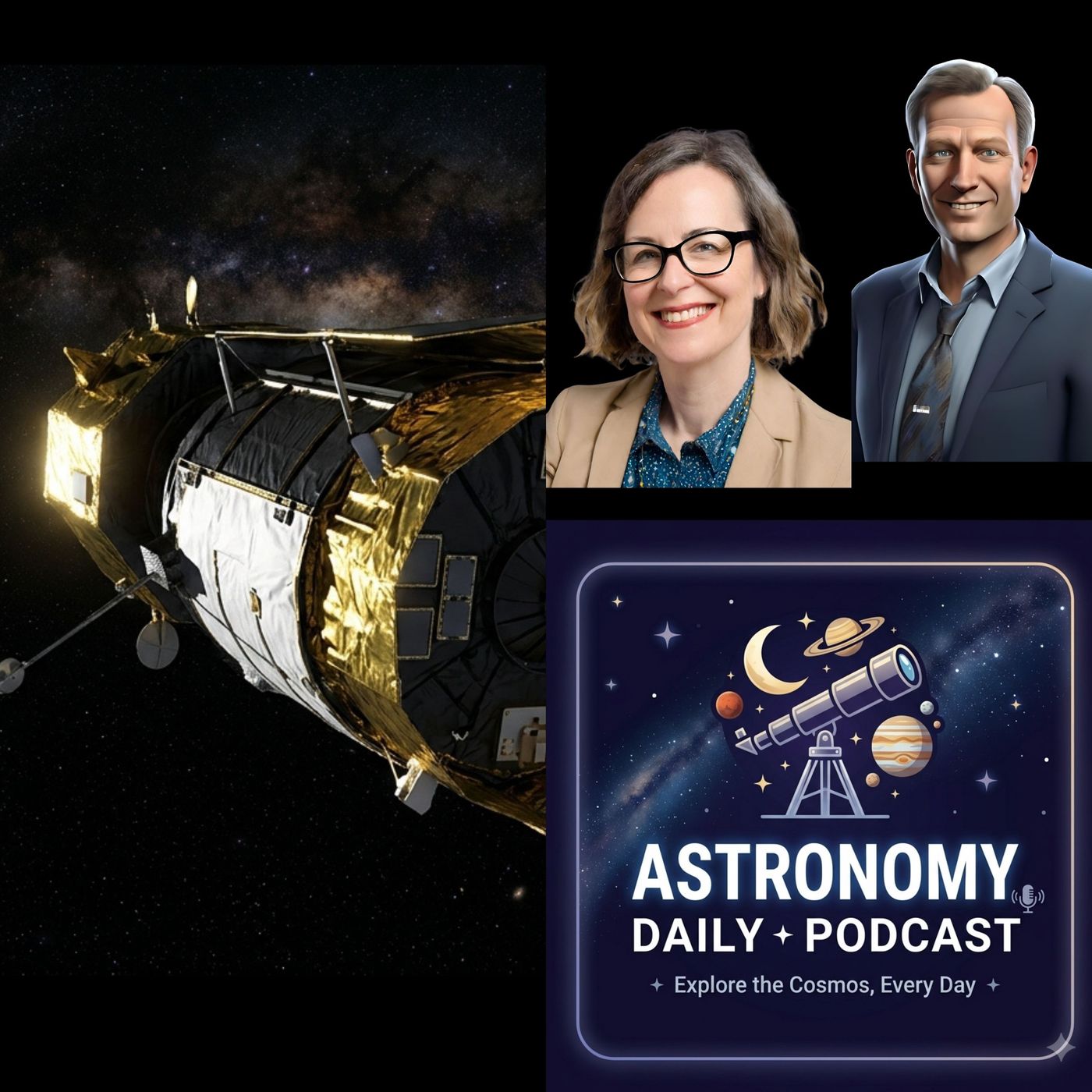
Roman Launches: A Telescope's Countdown Ends
About this episode
Links & sources: Space.com — Liftoff! NASA's Roman Space Telescope soars to the stars on a SpaceX Falcon Heavy rocket in spectacular launch (video) NASA Science (Roman blog) — NASA's Roman Space Telescope Launches NASA Science (Roman blog) — NASA Concludes Roman Space Telescope Launch Coverage Space.com — What time will SpaceX launch NASA's Roman Space Telescope? (Full mission timeline) Space.com — Goodbye, Falcon 9: SpaceX planning to retire workhorse launcher when Starship is up and running Teslarati — Elon Musk just set a condition that could end Falcon 9 as we know it ScienceDaily — The universe is still speeding up, but nobody knows why University of Bern (media relations) — Asteroid impact shaped the appearance of Mars' moon Deimos Nature Astronomy — Raducan, Agrusa, Asphaug et al. (2026), DOI 10.1038/s41550-026-02956-w When The Curves Line Up — 2026, August 31: Venus Nears Spica TelescopeAdvisor — Night Sky in September 2026: Saturn Approaching Opposition Follow us: @AstroDailyPod
Become a supporter of this podcast: https://www.spreaker.com/podcast/astronomy-daily-latest-space-news--5648921/support.
Sponsor Details:
Ensure your online privacy by using NordVPN. To get our special listener deal and save a lot of money, visit www.astronomydaily.io/nordvpn. You'll be glad you did!
Get the best secure and private email on the planet. Stop your Government, google and who knows who else spying on every email you write. Do what we did and use ProtonMail. They beleive in privacy and there are no ads in their business model...yet they still provide a free forever service. Check them out and get out special deal at www.astronomydaily.io/protonmail
Become a supporter of Astronomy Daily by joining our Supporters Club. Commercial free episodes daily are only a click way... Click Here
This episode includes AI-generated content.
More from Astronomy Daily: Latest Space News
Show notes Webb has read the dust of Cassiopeia A clump by clump, and the chemistry points to the star's inner burning shells merging in its final hours. Plus the week that was, the week ahead, and Ve…
Show notes The Supernova That Wouldn't Fade SN 2024vjm, discovered by BlackGEM at La Silla on 13 September 2024 in NGC 6744, is possibly the faintest supernova ever observed — 100 to 300 times dimmer…
Hera's first detailed look at Dimorphos reveals a stadium-sized crater across one whole face, a tumbling moonlet and hundreds of orbiting boulders — and settles the crater-versus-reshaping debate with…
Euclid has taken the quasar distance record past redshift eight for the first time: J1504+6252, “Dún Aonghasa”, at z = 8.13, seen 630 million years after the Big Bang with a black hole of about 360 mi…
ESA has explained BepiColombo's shortened capture burn: the spacecraft delivered about 77 percent of the planned push, landed in a longer orbit than planned, and still needs no extra burns, with Decem…