
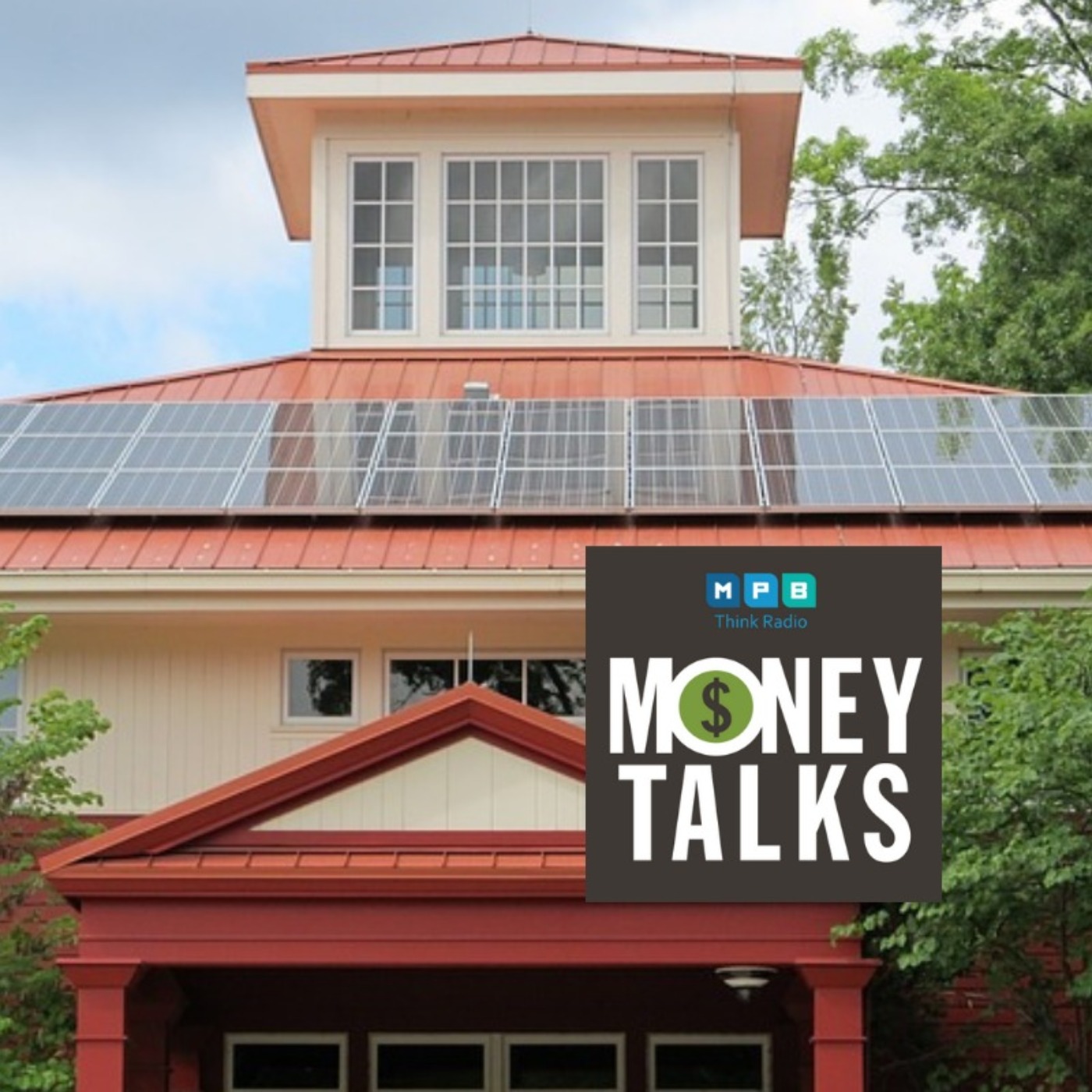
Money Talks: Solar Panels
About this episode
Friday, October 18, 2019
Let The Sunshine In!
For quite a while, I’ve been interested in solar. Fifteen years ago, when I began investigating, there was no one in Mississippi selling or installing solar systems. It seemed just a pipe dream.
Lately, more and more companies are popping up to provide this service. So I decided it was time to get serious. The other thing that pushed me to pursue this option was the lucrative tax credit offered on a solar installation and the fact that this credit was disappearing at the end of the year.
I had to convince my husband to go down this path. Wouldn’t the panels on the roof of our house detract from its appearance? Would future buyers really care about having solar panels? Did this really make financial sense?https://www.nerdwallet.com/blog/finance/save-money-putting-solar-panels-roof/
We met with two different companies. The first was all sales. There was no schematic showing where the panels would be located. No spreadsheets showing usage and payback period. Just a promise that the sun would provide ALL our electricity, and we would only pay a small connection fee each month. Wow! That sounded great.
Of course, if you install solar panels on your roof, you need to consider the age of the roof. Solar panels are designed to last about 25 years, which matches the age of a new roof. If you put on a new roof 10 years ago, this changes the calculation. Most installers prefer to put their panels on a new roof. So now you’re not just paying for solar panels, you’re paying for a new roof.
Of course, we were told if you couple the two, you may be able to get the tax credit applied to BOTH the panels and the roof. That sounded appealing. What is the tax credit, and when does it expire? It’s 30% of the cost, and it IS a credit, not a deduction. That means a dollar for dollar savings on about a third of the project. To qualify for the year-ending tax credit, I would need to sign up quickly (or so I was told).
A few qualifiers…
You are only supposed to take the credit on roofing for the portion of the roof actually under the panels. And in order to get the full advantage of that credit, you need the income (and the tax associated with it) that is big enough to offset that 30% break. Many retired people don’t have enough tax to pay now to take full advantage. Again, a change in calculus.
The second guy showed up with a laptop full of charts and graphs. He pointed out the direction the house was pointing, how the sun changes during the year, and the many shade trees surrounding our roof. He climbed on the roof with his many gadgets to verify his estimates. Full electricity? Not so much. He expects we could supply about half of our electricity with solar, and this would take many more panels than the first group suggested.
And now we’re confused. I really wanted to go solar. It seems like a great idea. We would be using a renewable resource. If the power company keeps getting rate increases, won’t that eventually pay off?
Turns out our payback period would be about 12 years, under a generous set of estimates. Also, we would have to load up our roof to get the most of the system. My husband is shaking his head now. Ultimately, the overall cost of panels and a new roof was now hitting the $40,000 to $50,000 range. Even with a generous tax credit, the dollars made my head spin.
One caution—many solar companies sell customers on a system by offering financing that matches what you were paying on an electric bill. Sounds good, right? But the rate on those financings is in the 7-8% range—not cheap! Also, what happens if you sell the house before you pay off the loan? Maybe you move, but you still have to pay that monthly bill.
We planned to pay the full bill up front to make this a purely economic decision. The problem we encountered is that our electricity is pretty cheap. The price per kilowatt in our area makes going solar unreasonable. I tried. I really tried, but in the end, it just didn’t make sense.
So we’re not going to spend $40,000 to $50,000 on an environmentally friendly and sustainable source of energy. We’re not going to be the progressive family in the neighborhood doing our part on climate issues. I had to give up my pipe dream.
Instead, I’m going to redo the kitchen.
https://newper.blogspot.com/2019/10/let-sunshine-in.html
Hosted on Acast. See acast.com/privacy for more information.
More from Money Talks
The holiday season is a time for giving, but it's also prime time for scammers looking to take advantage of unsuspecting shoppers. On this episode of Money Talks, Ryder and Meridith discuss common hol…
What happens to your property, accounts, and belongings after you’re gone? On this episode of Money Talks, Ryder and Meredith welcome attorney Rick Courtney to explain probate, how the process works i…
You’ve spent years saving for retirement. Now, when do you have to start taking money out, and how much? On this episode of Money Talks, Ryder and Meredith break down required minimum distributions, o…
On this episode of Money Talks, Ryder and Meredith break down the financial decisions that come with choosing health insurance. It’s open enrollment time, and this is the moment to review your coverag…
On this episode of Money Talks, Ryder Taff chats with the Mississippi Council on Economic Education (MCEE) and their stock market game team. The team consists of Rance Redmond, Kristian Scott, and Mad…