
Looking Back to the Cosmic Dawn
About this episode
SpaceTime Series 24 Episode 78
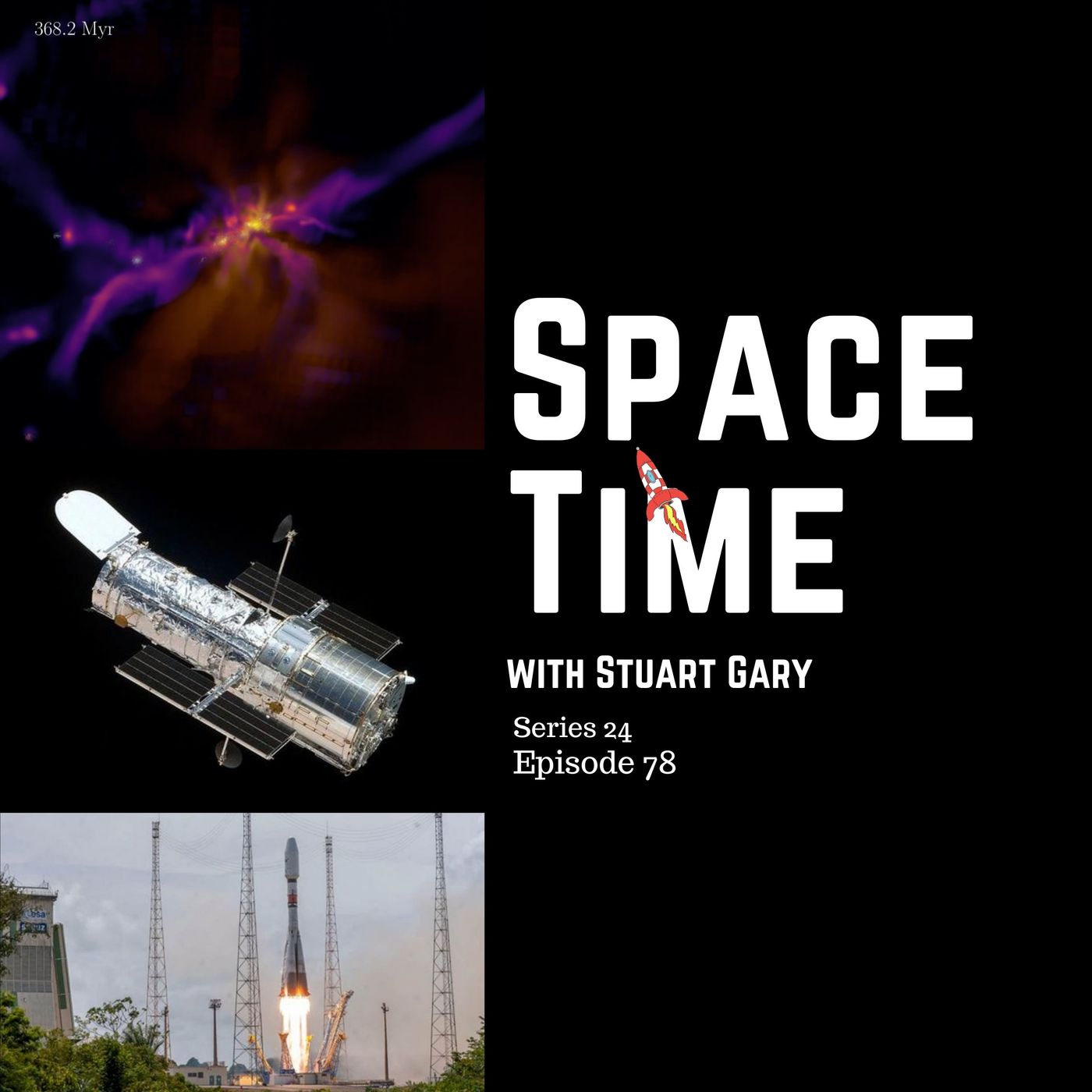
*Looking back to the cosmic dawn
A new study claims the first stars began shining between 250 and 350 million years after the big bang 13.8 billion years ago.
*Hubble still off line as technicians struggle to fix it
The Hubble Space Telescope remains off line following a major onboard computer crash last month.
*One Web latest launch adds to Star links satellite pollution
A Russian Soyuz rocket has successfully placed 36 British One web internet broad band telecommunication satellites into orbit.
*Skywatch July
Planet Earth reaches aphelion, The constellation Sagittarius pointing to the heart of the Milky Way galaxy, and the Delta Aquariids and Alpha Capricornids meteor showers.
For more SpaceTime and show links: https://linktr.ee/biteszHQ
Become a supporter of this podcast: https://www.spreaker.com/podcast/spacetime-with-stuart-gary--2458531/support.
More from SpaceTime with Stuart Gary
Friday SpaceTime 20261127 Series 29 Episode 142 BepiColombo arrives at Mercury After eight years of travelling through the inner Solar System, a gravity assist flyby around the Earth, two around Venus…
Wednesday SpaceTime 20261125 Series 29 Episode 141 China to land a spacecraft on the Jovian Moon Callisto China has officially unveiled plans to attempt humanity’s first-ever landing on one of Jupiter…
Monday SpaceTime 20261123 Series 29 Episode 140 Debris from an ancient stellar merger blast still raining down on Earth A new study has discovered that debris is still raining down on planet Earth fro…
Friday SpaceTime 20261120 Series 29 Episode 139 New clues about origins of the ice giants Uranus and Neptune New study suggests the ice worlds of Uranus and Neptune had very different origins despite…
Wednesday SpaceTime 20261118 Series 29 Episode 138 Voyager 1 spacecraft reaches a full light day away from Earth NASA’s Voyager 1 spacecraft has made history today becoming the first man made object t…