
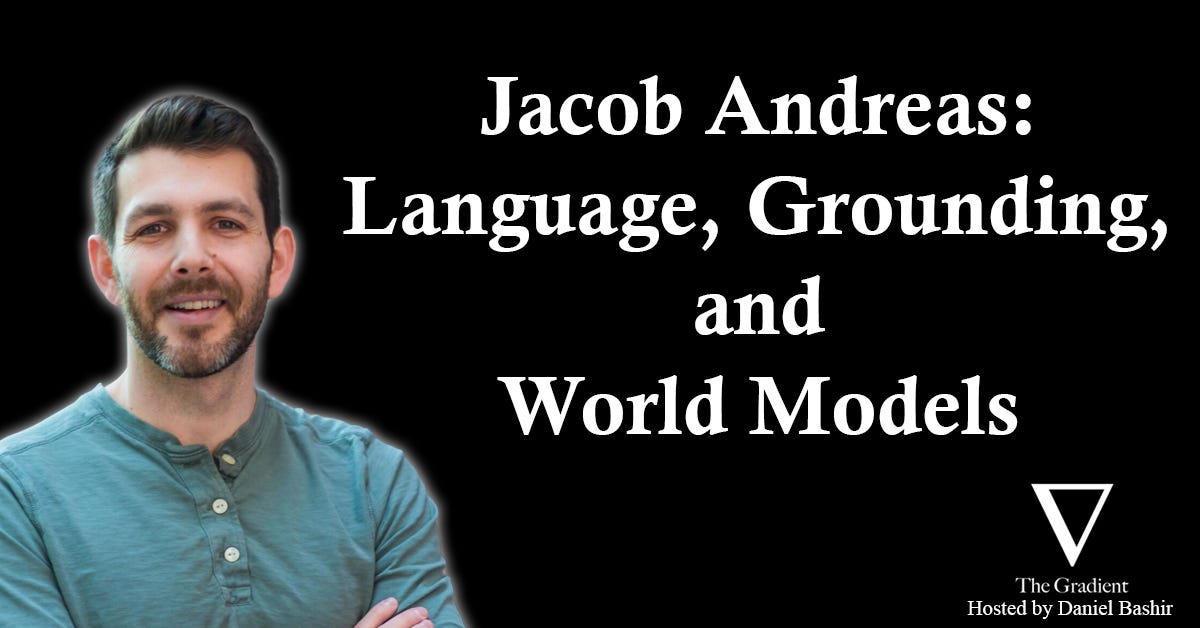
Jacob Andreas: Language, Grounding, and World Models
About this episode
Episode 140
I spoke with Professor Jacob Andreas about:
* Language and the world
* World models
* How he’s developed as a scientist
Enjoy!
Jacob is an associate professor at MIT in the Department of Electrical Engineering and Computer Science as well as the Computer Science and Artificial Intelligence Laboratory. His research aims to understand the computational foundations of language learning, and to build intelligent systems that can learn from human guidance. Jacob earned his Ph.D. from UC Berkeley, his M.Phil. from Cambridge (where he studied as a Churchill scholar) and his B.S. from Columbia. He has received a Sloan fellowship, an NSF CAREER award, MIT's Junior Bose and Kolokotrones teaching awards, and paper awards at ACL, ICML and NAACL.
Find me on Twitter for updates on new episodes, and reach me at [email protected] for feedback, ideas, guest suggestions.
Subscribe to The Gradient Podcast: Apple Podcasts | Spotify | Pocket Casts | RSSFollow The Gradient on Twitter
Outline:
* (00:00) Intro
* (00:40) Jacob’s relationship with grounding fundamentalism
* (05:21) Jacob’s reaction to LLMs
* (11:24) Grounding language — is there a philosophical problem?
* (15:54) Grounding and language modeling
* (24:00) Analogies between humans and LMs
* (30:46) Grounding language with points and paths in continuous spaces
* (32:00) Neo-Davidsonian formal semantics
* (36:27) Evolving assumptions about structure prediction
* (40:14) Segmentation and event structure
* (42:33) How much do word embeddings encode about syntax?
* (43:10) Jacob’s process for studying scientific questions
* (45:38) Experiments and hypotheses
* (53:01) Calibrating assumptions as a researcher
* (54:08) Flexibility in research
* (56:09) Measuring Compositionality in Representation Learning
* (56:50) Developing an independent research agenda and developing a lab culture
* (1:03:25) Language Models as Agent Models
* (1:04:30) Background
* (1:08:33) Toy experiments and interpretability research
* (1:13:30) Developing effective toy experiments
* (1:15:25) Language Models, World Models, and Human Model-Building
* (1:15:56) OthelloGPT’s bag of heuristics and multiple “world models”
* (1:21:32) What is a world model?
* (1:23:45) The Big Question — from meaning to world models
* (1:28:21) From “meaning” to precise questions about LMs
* (1:32:01) Mechanistic interpretability and reading tea leaves
* (1:35:38) Language and the world
* (1:38:07) Towards better language models
* (1:43:45) Model editing
* (1:45:50) On academia’s role in NLP research
* (1:49:13) On good science
* (1:52:36) Outro
Links:
* Jacob’s homepage and Twitter
* Language Models, World Models, and Human Model-Building
* Papers
* Semantic Parsing as Machine Translation (2013)
* Grounding language with points and paths in continuous spaces (2014)
* How much do word embeddings encode about syntax? (2014)
* Translating neuralese (2017)
* Analogs of linguistic structure in deep representations (2017)
* Learning with latent language (2018)
* Learning from Language (2018)
* Measuring Compositionality in Representation Learning (2019)
* Experience grounds language (2020)
* Language Models as Agent Models (2022)
Get full access to The Gradient at thegradientpub.substack.com/subscribe
More from The Gradient: Perspectives on AI
Episode 144 Happy New Year! This is one of my favorite episodes of the year — for the fourth time, Nathan Benaich and I did our yearly roundup of AI news and advancements, including selections from th…
Episode 143 I spoke with Iason Gabriel about: * Value alignment * Technology and worldmaking * How AI systems affect individuals and the social world Iason is a philosopher and Senior Staff Research S…
Episode 142 Happy holidays! This is one of my favorite episodes of the year — for the third time, Nathan Benaich and I did our yearly roundup of all the AI news and advancements you need to know. This…
Episode 141 I spoke with Professor Philip Goff about: * What a “post-Galilean” science of consciousness looks like * How panpsychism helps explain consciousness and the hybrid cosmopsychist view Enjoy…
Hi everyone! If you’re a new subscriber or listener, welcome. If you’re not new, you’ve probably noticed that things have slowed down from us a bit recently. Hugh Zhang, Andrey Kurenkov and I sat down…