
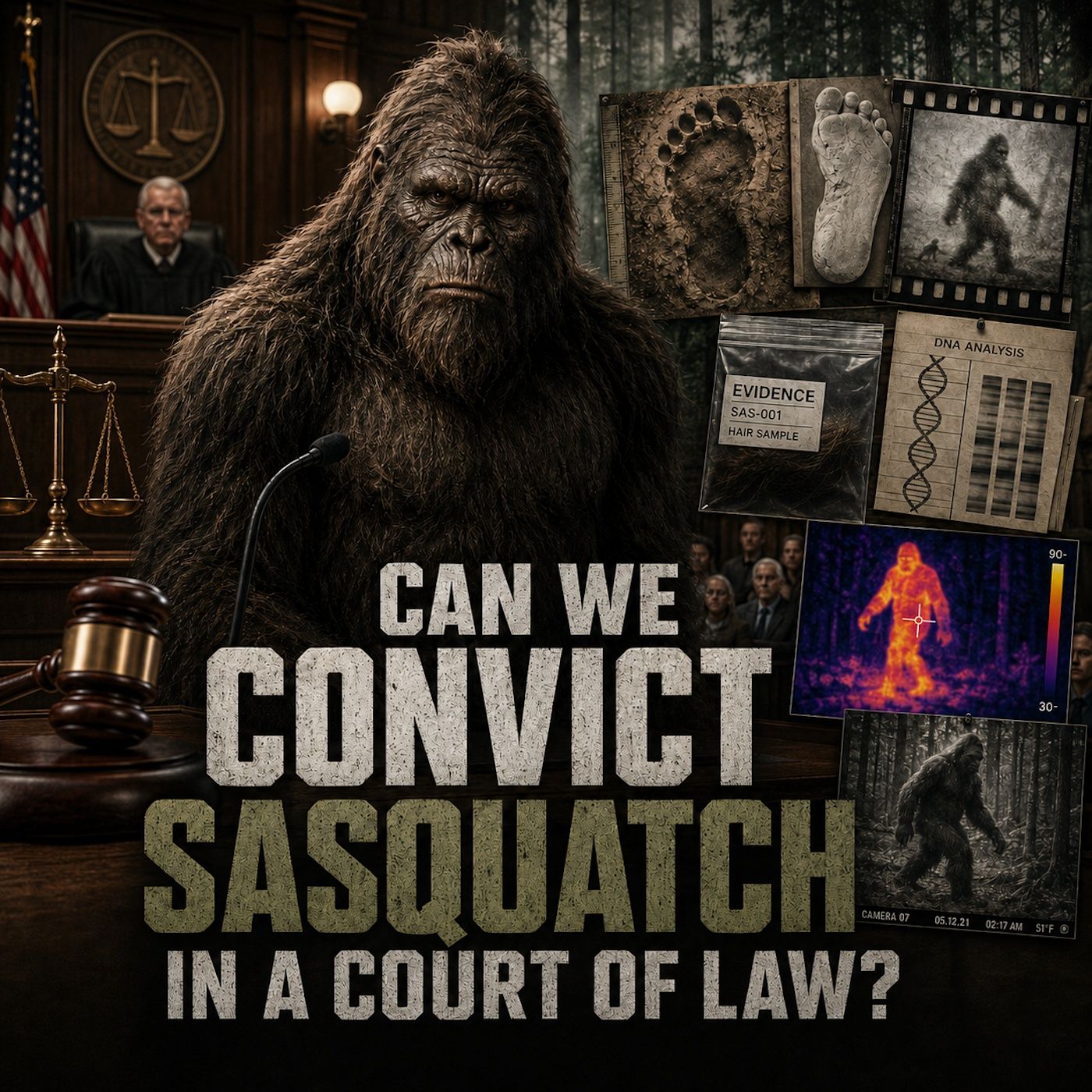
Is Bigfoot Guilty?
About this episode
Drawing on sixteen years carrying a badge, including time with the Atlanta Police Department, and close to forty years chasing this animal in the field, Brian builds the Sasquatch case the way a working investigator builds any case, brick by brick, and then tears it apart on cross-examination so you hear the strongest version of both sides before you render a verdict.
This is a working tour through the five kinds of evidence that show up in nearly every American courtroom, and how the Bigfoot question performs against each one. Real evidence, the physical proof, gets weighed against the footprint casts, the dermal ridges, the alleged hair and the chain-of-custody problems that would sink half of it before trial.
Documentary evidence, demonstrative evidence, and the famous Patterson-Gimlin film all face the same scrutiny, with an honest look at the costume claims, the hoaxers who confessed, and why a piece of footage shot at Bluff Creek in nineteen sixty-seven still resists explanation more than half a century later. Testimonial evidence, the tens of thousands of eyewitness accounts from police officers, wildlife biologists, soldiers, hunters and truckers, gets prosecuted hard and then cross-examined just as hard, because eyewitness memory is the most fragile thing in the entire courtroom.
And digital evidence, the trail-camera photos, thermal clips and cell-phone video, runs straight into the deepfake era, where better technology has somehow made the case harder to prove rather than easier.Along the way the episode walks through the real material that defines this subject, from the Bossburg Cripplefoot tracks and the work of Grover Krantz and Jeff Meldrum to the Oxford DNA study led by Bryan Sykes, the Melba Ketchum results, the new-species precedents of the mountain gorilla, the coelacanth and the saola, and the body-shaped hole at the center of the whole question.
Brian lays out the difference between the preponderance standard and proof beyond a reasonable doubt, explains exactly why a circumstantial case can still convict, and then does the thing most people in this field never have the nerve to do. He hands you the verdict. He also puts his own card on the table, including the daylight sighting he had in Washington State in twenty twenty-four, and explains why, as an atheist and a rigor-first researcher with no patience for the woo, he still argues that his own eyewitness account has no business moving the jury.
If you care about Bigfoot evidence, Sasquatch research, cryptid investigation done with actual standards, and the honest question of what it would really take to confirm an unknown North American primate, this one is built for you. You are the jury. Weigh it honestly.
Email Brian
Join Our FREE Newsletter
Get Brian's Books
Leave Us A Voicemail
Visit Our Website
Become a supporter of this podcast: https://www.spreaker.com/podcast/sasquatch-odyssey--4839697/support.
Have you had a Bigfoot encounter, Sasquatch sighting, Dogman experience, or...
More from Sasquatch Odyssey
Jason returns to Sasquatch Odyssey to share a series of unsettling childhood experiences that unfolded deep in the Pennsylvania wilderness. During family camping trips in the remote Pine Valley region…
Fred from the SubArctic Alaska Sasquatch YouTube channel is back with three chilling accounts from the remote wilderness of Alaska, where encounters with the unexplained can leave witnesses questionin…
On October 7, 2017, Tom Rigsby watched something large, dark, and walking upright cross a remote logging road in western North Carolina. The encounter lasted less than five seconds. Tom waited two day…
Is the Patterson–Gimlin Film finally beginning to unravel? And what does newly discovered footage reveal about the most famous Bigfoot film ever recorded? On this episode of Sasquatch Odyssey, Brian w…
For four generations, Jimmy’s family kept an extraordinary secret hidden on eighty acres in the mountains of North Georgia. But as the legend of Bigfoot captured America’s attention, protecting that s…